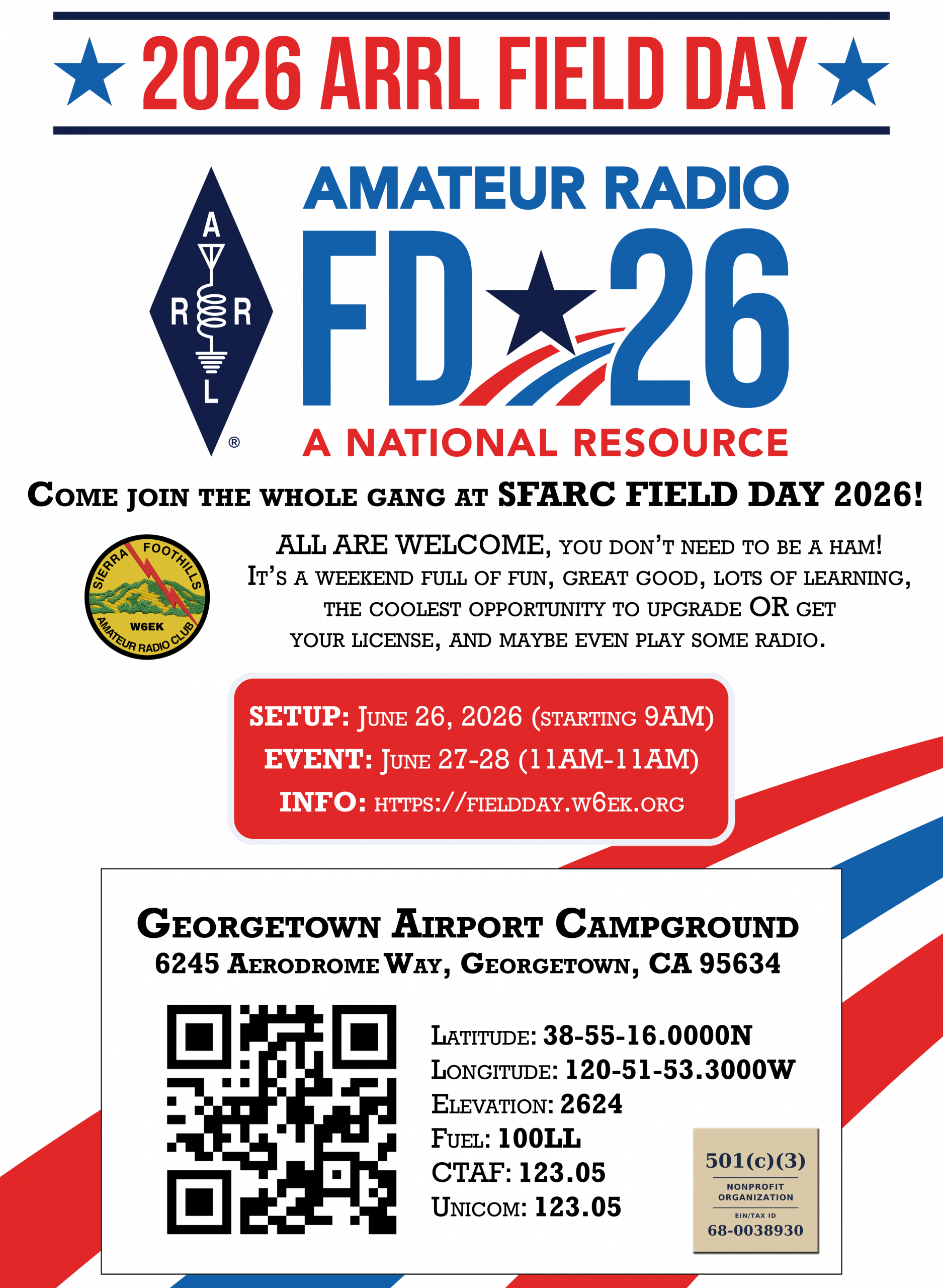
Event Dates
June 27–28, 2026
1800 UTC Sat – 2059 UTC Sun
Entry Deadline
Tuesday, July 28, 2026
Late entries cannot be accepted
1. Eligibility
Field Day is open to all amateurs in the areas covered by the ARRL/RAC Field Organizations and countries within IARU Region 2. DX stations residing in other regions may be contacted for credit and may submit entries as check-logs.
2. Object
To work as many stations as possible on the 160-, 80-, 40-, 20-, 15- and 10-Meter HF bands, as well as all bands 50 MHz and above, and in doing so to learn to operate in abnormal situations in less-than-optimal conditions. A premium is placed on developing skills to meet the challenges of emergency preparedness as well as to acquaint the general public with the capabilities of Amateur Radio. See also recommended frequencies FAQ.
3. Date and Time Period
Field Day 2026 will be held June 27–28. Field Day is ALWAYS the fourth full weekend of June, beginning at 1800 UTC Saturday and ending at 2059 UTC Sunday.
3.1. Class A and B (see below) stations that do not begin setting up until 1800 UTC on Saturday may operate the entire 27-hour Field Day period.
3.2. Stations who begin setting up before 1800 UTC Saturday may work only 24 consecutive hours, commencing when on-the-air operations begin.
3.3. No class A or B station may begin its set-up earlier than 0000 UTC on the Friday (Thursday afternoon or evening local time) preceding the Field Day period. Cumulative set-up time shall not exceed a total of 24 hours.
4. Entry Categories
Field Day entries are classified according to the maximum number of simultaneously transmitted signals, followed by a designator indicating the nature of their individual or group participation. The minimum number of transmitters that must be claimed is one (1). Twenty (20) transmitters maximum are eligible for the purpose of calculating bonus points (2,000 points maximum). However, additional transmitters which may legitimately be used simultaneously will determine your entry category classification, but will not earn additional bonus points (i.e. 22 transmitters = 22A).
The use of switching systems that allow for lock-outs in order to use multiple transmitters (i.e., an “octopus”) in an attempt to enter a lower-number-of-transmitters class are prohibited (i.e. using 2 transmitters that can transmit simultaneously, with two operators, and a lock-out system and entering class 1A). The use of simulcasting devices which allow a single operator to key and transmit on more than one transmitter at a time, is prohibited. Bonus stations, such as the GOTA station and satellite station do not count towards determining the number of transmitters for the class and do not qualify for transmitter bonus points.
4.1. Class A — Club / Non-Club Portable
Club or a non-club group of three or more persons set up specifically for Field Day. Such stations must be located in places that are not regular station locations and must not use facilities installed for permanent station use, or use any structure installed permanently for Field Day. A single licensee or trustee for the entry is responsible for the group entry. All equipment (including antennas) must lie within a circle whose diameter does not exceed 300 meters (1000 feet). To be listed as Class A, all contacts must be made with transmitter(s) and receiver(s) operating independent of commercial power mains. Entrants whom for any reason operate a transmitter or receiver from a commercial main for one or more contacts will be listed separately as Class A-Commercial.
4.1.1. Get On The Air (GOTA) Station (updated for 2025)
Any Class A or F entry may also operate one additional station without changing its base entry category, known as the Get On The Air (GOTA) station. This GOTA station may operate on any Field Day band, HF or VHF, but is limited to one GOTA station transmitted signal at any time.
4.1.1.1. This station must use a different callsign from the primary Field Day station. The GOTA station must use the same callsign for the duration of the event regardless if operators change. The GOTA station uses the same exchange as its parent.
4.1.1.2. The GOTA station may be operated by any person licensed since the previous year’s Field Day, regardless of license class. It may also be operated by a generally inactive licensee. Non-licensed persons may participate under the direct supervision of an appropriate control operator. A list of operators and participants must be included on the required summary sheet to ARRL HQ.
4.1.1.3. As per FCC rules, this station must have a valid control operator present at the control point if operating beyond the license privileges of the participant using the station.
4.1.1.4. The maximum transmitter output power for the GOTA station shall be 100 watts. If the primary Field Day group is claiming the QRP multiplier level of five (5), the maximum transmitter output power of the GOTA station may not exceed 5 watts.
4.1.1.5. There is no limit to the number of contacts made by the GOTA station. QSOs made by this station may be claimed for credit by its primary Field Day operation. In addition, bonus points may be earned by this station under rule 7.3.13.
4.1.1.6. The GOTA station may operate on any Field Day band. Only one transmitted signal is allowed from the GOTA station at any time.
4.1.1.7. The GOTA station does not affect the additional VHF/UHF station provided for under Field Day Rule 4.1.2. for Class A stations.
4.1.1.8. Participants are reminded that non-licensed participants working under the direction of a valid control operator may only communicate with other W/VE stations or with stations in countries with which the US has entered a third-party agreement.
4.1.1.9. The GOTA station does not qualify as an additional transmitter when determining the number of transmitters eligible for the 100-point emergency power bonus under Rule 7.3.1.
4.1.2. Free VHF Station
All Class A entries may also operate one additional transmitter if it operates exclusively on any band or combination of bands above 50 MHz (VHF/UHF) without changing its basic entry classification. This station does not qualify for a 100-point bonus as an additional transmitter. This station may be operated for the clubs Field Day period and all contacts count for QSO credit. It is operated using the primary callsign and exchange of the main Field Day group and is separate and distinct from the GOTA station.
Other Entry Classes
4.2. Class A — Battery
Club or non-club group of 3+ persons. All contacts made at 5 watts or less with a power source other than commercial mains or motor-driven generator (batteries, solar, water-driven). Other provisions same as Class A. Eligible for GOTA if it meets the 5W power requirement. Listed separately.
4.3. Class B — One or Two Person Portable
Field Day station set up and operated by no more than two persons. Other provisions same as Class A except not eligible for GOTA or free VHF station. One- and two-person entries listed separately.
4.4. Class B — Battery
No more than two persons. All contacts at 5 watts or less from non-commercial / non-generator power. Other provisions same as Class A except not eligible for GOTA or free VHF. Listed separately.
4.5. Class C — Mobile
Stations in vehicles capable of operating while in motion and normally operated this way. Includes maritime and aeronautical mobile. Car battery/alternator qualifies for emergency power but not for the ×5 multiplier.
4.6. Class D — Home Stations
Stations operating from permanent or licensed station locations using commercial power. Class D may work all Field Day stations.
4.7. Class E — Home Stations, Emergency Power
Same as Class D, but using emergency power for transmitters and receivers. Class E may work all Field Day stations.
4.8. Class F — Emergency Operations Centers (EOC)
An amateur radio station at an established EOC activated by a club or non-club group. Class F operation must take place at an established EOC site. Stations may utilize equipment and antennas temporarily or permanently installed at the EOC for the event. Entries will be reported according to number of transmitters in simultaneous operation. Class F stations are eligible for a free VHF station.
4.8.1. For Field Day purposes, an EOC is defined as a facility established by:
- a) a Federal, State, County, City or other Civil Government, agency or administrative entity; or,
- b) a Chapter of a national or international served agency (such as American Red Cross or Salvation Army) with which your local group has an established operating arrangement.
4.8.1.1. A private company EOC does not qualify for Class F status unless approved by the ARRL Field Day Manager.
4.8.2. Planning of a Class F operation must take place in conjunction and cooperation with the staff of the EOC being activated.
4.8.3. Other provisions not covered are the same as Class A.
4.8.4. A Class F station may claim the emergency power bonus if emergency power is available at the EOC site.
4.8.4.1. The emergency power source must be tested during the Field Day period but you are not required to run the Class F operation under emergency power.
5. Exchange
Stations in ARRL / RAC sections will exchange their Field Day operating Class and ARRL / RAC section.
Example: A three-transmitter Class A station in Connecticut which also has a GOTA station and the extra VHF station would send “3A CT” on CW or Digital, or “3 Alpha Connecticut” on Phone. DX stations send operating class and the term DX (i.e. 2A DX).
6. Miscellaneous Rules
6.1. A person may not contact for QSO credit any station from which they also participate.
6.2. A transmitter/receiver/transceiver used to contact one or more Field Day stations may not subsequently be used under any other callsign to participate in Field Day. Family stations are exempt provided the subsequent callsign used is issued to and used by a different family member.
6.3. Field Day contacts are allowed using Phone, CW and Digital (non-CW) modes. Stations can be worked once per band per mode under this rule.
6.4. Each contact must include contemporaneous direct initiation by both operators making a contact. Initiation of a contact may be by either local or remote control. Fully automated contacts are prohibited.
6.5. For any of the three event modes (CW, Phone, or Digital), only one transmitted signal (or data stream) per band is permitted at any time. Multi Streaming (e.g. Fox and Hound Mode, DXpedition Mode, or MSHV) is prohibited.
6.6. All voice contacts are equivalent.
6.7. All non-CW digital contacts are equivalent.
6.8. Cross-band contacts are not permitted (Satellite QSOs cross-band contacts are exempted).
6.9. The use of more than one transmitter at the same time on a single band-mode is prohibited. Exception: a dedicated GOTA station may operate as prescribed in Rule 4.1.
6.10. No repeater contacts are allowed.
6.11. Batteries may be charged while in use. Except for Class D stations, the batteries must be charged from a power source other than commercial power mains. To claim the power multiplier of five, the batteries must be charged from something other than a motor-driven generator or commercial mains.
6.12. All stations for a single entry must be operated under one callsign, except when a dedicated GOTA station is operated as provided under Field Day Rule 4.1.1.; it uses a single, separate callsign.
7. Scoring
Scores are based on the total number of QSO points times the power multiplier corresponding to the highest power level under which any contact was made during the Field Day period plus the bonus points.
Aggregate Club Score: An aggregate club score will also be published, which will be the sum of all individual entries indicating a specific club. Participants from any Class can optionally include a single club name with their submitted results. For example, if Podunk Hollow Radio Club members Becky, W1BXY, and Hiram, W1AW, both participate — Hiram from his Class D home station, and Becky from her Class C mobile station — both can include the radio club’s name when reporting their individual results. Published results will list individual scores plus a combined score for all entries identified as Podunk Hollow Radio Club.
7.1. QSO Points
| Mode |
Points per Contact |
| Phone |
1 point |
| CW |
2 points |
| Digital (non-CW) |
2 points |
7.2. Power Multipliers
The power multiplier that applies is determined by the highest power output of any of the transmitters used during the Field Day operation. Power output for classes A, B and C cannot exceed 500 watts PEP. Power output for classes D, E and F cannot exceed 100 watts PEP.
| Power & Source |
Multiplier |
| 5W or less from non-commercial, non-generator source (battery, solar, water) |
×5 |
| 5W or less from commercial mains or motor-driven generator |
×2 |
| Up to 100W |
×2 |
| Greater than 100W |
×1 |
Important: The multiplier for the entry is determined by the maximum output of any transmitter used. Example: a group with one QRP station at 3W and a second station at 500W gets the ×1 multiplier on all contacts.
7.3. Bonus Points
All stations are eligible for certain bonus points, depending on entry class. Bonus points are added after the multiplier is applied. Bonus points are awarded only when claimed on the summary sheet with required proof.
7.3.1.100% Emergency Power100 / transmitter (max 2,000)
If all contacts are made only using emergency power, up to a total of 20 transmitters. GOTA and free VHF stations don’t qualify and shouldn’t be in the transmitter total. All transmitting equipment at the site must operate from a power source completely independent of commercial power mains. Example: a club operating 3 transmitters plus a GOTA station and using 100% emergency power receives 300 bonus points.
Available to Classes A, B, C, E, and F.
7.3.2.Media Publicity100 pts
For obtaining publicity from the local media. A copy of the actual media publicity received (newspaper article, etc.) must be submitted. Any combination of bona fide media hits qualifies. Coverage of upcoming or ongoing Field Day activity, or results, on a news media site (including the media site’s Facebook, Twitter, or Instagram) meets the criteria.
Available to all Classes.
7.3.3.Public Location100 pts
For physically locating the Field Day operation in a public place (shopping center, park, school campus, etc.) and actively welcoming the public. Person(s) shall be available to greet the public and be identified by some sort of name badge. The intent is for amateur radio to not only be on display but to engage any visitors.
Available to Classes A, B and F.
7.3.4.Public Information Table100 pts
For a Public Information Table at the Field Day site. The purpose is to make appropriate handouts and information available to the visiting public.
Available to Classes A, B and F.
7.3.5.Message Origination to Section Manager100 pts
For origination of a formal message to the ARRL Section Manager or Section Emergency Coordinator. Include club name, number of participants, location, and number of ARES operators involved. Must be transmitted during the Field Day period and a copy included in your submission in standard NTS or ICS-213 format (or equivalent content). The message must leave or enter the Field Day operation via amateur radio RF. This is separate from messages handled in Rule 7.3.6.
Available to all Classes.
7.3.6.Message Handling10 pts each (max 100)
For each formal message originated, relayed, or received and delivered during the Field Day period, up to ten messages. Copies must be included with the report. The message to the SM/SEC under Rule 7.3.5 doesn’t count toward this total. Messages must be in standard NTS or ICS-213 format (or equivalent) and must leave or enter the Field Day operation via amateur radio RF.
Available to all Classes.
7.3.7.Satellite QSO100 pts
For successfully completing at least one QSO via an amateur radio satellite during the Field Day period. Groups are allowed one dedicated satellite transmitter station without increasing their entry category. Satellite QSOs also count for regular QSO credit; list them separately on the summary sheet as a separate “band.” No additional bonus for contacting different satellites. The QSO must be between two Earth stations through a satellite. 7.3.7.1. Stations are limited to one (1) completed QSO on any single channel FM satellite.
Available to Classes A, B, and F.
7.3.8.Alternate Power100 pts
For groups making a minimum of five QSOs without using power from commercial mains or petroleum-driven generator. Means an “alternate” energy source such as solar, wind, methane, or water — including batteries charged by natural means (not dry cells). The natural-power transmitter counts as an additional transmitter; if you don’t want to increase your category, take one of your other transmitters off the air while it operates. A separate list of natural-power QSOs should be submitted with your entry.
Available to Classes A, B, E, and F.
7.3.9.W1AW Bulletin100 pts
For copying the special Field Day bulletin transmitted by W1AW (or K6KPH) during its operating schedule on the Field Day weekend. An accurate copy of the message must be included in your submission. Note: must be copied via amateur radio — it will not be in Internet bulletins from HQ or on Internet BBS sites.
Available to all Classes.
7.3.10.Educational Activity Bonus100 pts
One bonus may be claimed if your operation includes a specific educational-related activity related to amateur radio. Must be a formal activity. Can be repeated during the Field Day period but only one bonus is earned. See FAQ in the complete Field Day packet.
Available to Classes A & F, and to clubs/groups operating from a club station in Class D and E with 3+ participants.
7.3.11.Site Visit by an Elected Governmental Official100 pts
One bonus may be claimed if your site is visited by an elected government official as the result of an invitation issued by your group.
Available to all Classes.
7.3.12.Site Visit by a Representative of an Agency100 pts
One bonus if your site is visited by a representative of an agency served by ARES in your local community (American Red Cross, Salvation Army, local Emergency Management, law enforcement, etc.) as the result of an invitation issued by your group. ARRL officials (SM, SEC, DEC, EC, etc.) do not qualify.
Available to all Classes.
7.3.13.GOTA Bonus5 pts/contact + 100 (Coach)
7.3.13.1. Any successfully completed contact made by an operator at the GOTA station is worth 5 bonus points, regardless of mode. No limit on the number of contacts a single GOTA operator can make. GOTA bonus points are not multiplied by the power multiplier (clarification of the rules published in 2023).
7.3.13.2. If a GOTA station is supervised by a GOTA Coach, a single 100-point bonus is earned.
- 7.3.13.2.1. The GOTA Coach supervises the operator (answering questions, talking them through contacts) but may not make contacts or perform logging functions.
- 7.3.13.2.2. Must be a designated GOTA Coach present and supervising for at least 10 contacts.
Available to Class A and F entries operating a GOTA station.
7.3.14.Web Submission50 pts
Available to all Classes.
7.3.15.Field Day Youth Participation20 pts each (max 100)
7.3.15.1. A 20-point bonus (up to a max of 100) for any Class A, C, D, E, or F group, for each participant age 18 or younger who completes at least one QSO.
7.3.15.2. For 1-person Class B, 20 points if the operator is age 18 or younger. For 2-person Class B, 20 points for each operator age 18 or younger (max 40 points). Class B is still only a 1- or 2-person operation — this bonus does not allow more participants.
Available to all Classes (with rules above).
7.3.16.Social Media100 pts
For promoting your Field Day activation to the general public via an active, recognized, and utilized social media platform (Facebook, Twitter, Instagram, etc.). Available to bona fide amateur radio clubs and Field Day groups that welcome visitors. Individual participants do not qualify. Club websites do not qualify.
Available to all classes.
7.3.17.Safety Officer Bonus100 pts
For having a person serving as Safety Officer for groups setting up Class A stations. The Safety Officer must verify all safety concerns on the Safety Officer Check List (in the ARRL Field Day Packet) have been adequately met. This is an active bonus — simply designating someone doesn’t earn it. A signed copy of the Check List must be included in supporting documentation.
Available to Class A entries only.
7.3.18.Field Day Site Responsibilities Bonus50 pts
For having a person ensure the Field Day site is free of hazards and that safety precautions have been taken throughout the event, and providing a point of contact to the visiting public or served-agency officials. A signed copy of the Field Day Responsibilities Check List must be included in supporting documentation.
Available to Class B, C, D, E, or F entries.
8. Reporting
8.1. Submission Methods
8.1.2. Postal Mail
Field Day Entries
225 Main St
Newington, CT 06111
(tracking highly recommended)
Deadline
Postmarked / submitted by Tuesday, July 28, 2026
Late entries cannot be accepted (Rule 8.2)
8.3. A Complete Web App Entry Consists Of:
8.3.1. An official ARRL summary sheet completed via the web app.
8.3.2. Supporting information uploaded via web app, including:
- 8.3.2.1. An attached list of stations worked by band/mode (dupe sheet, alpha/numeric list, or Cabrillo log).
- 8.3.2.2. Proof of bonus points claimed (press releases, NTS messages, photographs, etc.).
- 8.3.2.3. The web app will display a confirmation number and email a confirmation. Save this!
8.4. Email Submission Includes:
8.4.1. An electronic copy of an ARRL summary sheet, completely and accurately filled out.
8.4.2. A list of stations worked by band/mode during the Field Day period (dupe sheet or alpha/numeric list).
8.4.3. Proofs of bonus points claimed (visitor logs, media coverage, NTS messages, photographs, etc.).
8.5. Postal Mail Submission Includes:
8.5.1. A complete and accurate ARRL summary sheet.
8.5.2. An accompanying list of stations worked by band/mode (dupe sheet or alpha/numeric list).
8.5.3. Proofs of bonus points claimed.
Other Reporting Notes
8.6. Complete station logs are NOT required. Maintain logs for one year in case ARRL HQ requests them. A list of stations worked sorted by band and mode (dupe sheet) IS required.
8.7. Cabrillo format log files are NOT required, but accepted in lieu of dupe sheets. They don’t constitute an entry on their own — the web app or summary sheet is also needed.
8.8. Digital images of proof of bonus points are acceptable.
8.9. Electronic submissions are considered signed when submitted.
9. Miscellaneous
9.1. The schedule of bulletin times for W1AW is included in this announcement. While W1AW does not have regular bulletins on weekends, the Field Day message will be sent according to the schedule. Bulletins will be transmitted on the regular W1AW frequencies listed in QST. The PSK31 bulletin will be transmitted on the W1AW teleprinter frequencies. The special Field Day bulletin will also be transmitted from station K6KPH on the West Coast.
9.2. Decisions of the ARRL Awards Committee are final in adjudicating Field Day problems.
9.3. The complete Field Day information package may be obtained via download from the Field Day home page at
www.arrl.org/field-day.
9.4. For more Field Day information/questions contact
fdinfo@arrl.org or phone (860) 594-0232.