All posts by Smitty (WB1G)

Photo Gallery Uploader (Page)

UPLOAD YOUR PHOTOS

Photo Gallery (Page)

Is Broadcast Radio Dead (Tile)

Is Broadcast Radio Dead?

It’s complicated, and it starts with relevance.
by Smitty (WB1G)

Having spent 15 years working in radio, in front of and behind the microphone, I am passionate about this topic. So the best place to start is whether radio is still relevant. The simple answer is yes, but limited to a demographic that is aging out. The primary radio advertising “buying demo” is adults 25–54. As Gen Xers get older and head into retirement, spending becomes more calculated. Broadcast radio remains dominant in vehicles, with AM/FM representing over 70% of ad-supported in-car listening among the upper end of the demographic. Radio remains a strong reach medium, but it is no longer the center of people’s audio lives. The key is the “upper end of the demographic”.

What’s In A Name?

Ask your kids or grandkids what their favorite radio station is and who their favorite DJ is. Among ages 13–24, over-the-air radio accounts for roughly 16% of total audio time. Only 10% of ages 13–17 and 5% of ages 18–24 identify AM/FM as their primary source for discovering music (from Radio World and Radio Ink).

Plenty of under-25s “hear radio”, often in a parent’s car, workplace, or shared setting, but that doesn’t mean they intentionally selected the station, know its call letters or frequency, or could name it when asked. In advertisers’ eyes, that is not good.

What about AM radio?
According to Edison Research, AM radio is in a substantially weaker position with people under 25 than FM radio. Current national studies generally combine AM and FM, so there is no credible published percentage showing how many under-25s can name an AM station. AM isn’t dead as a distribution system, but among younger listeners it has a serious brand awareness and intentional-use problem that makes ad monetization challenging beyond radio’s broader challenge. Large antenna systems and towers require substantial land, ground radials, and specialized maintenance, which makes AM cost prohibitive in many markets. A National Alliance of State Broadcasters Associations survey of more than 1,000 AM stations found that over 70% of AM radio stations on the air today have an FM simulcast.

Looking into the crystal ball, how much time do we have left? In the United States, FM radio likely has at least another 20 years as a meaningful broadcast service; however, that doesn’t indicate profitability. Among existing radio fans surveyed by Jacobs Media, broadcast delivery fell from 85% of station listening in 2013 to 54% in 2026. Digital delivery rose from 14% to 44%; among Gen Z, digital has already slightly passed broadcast. The greater near-term risk isn’t that the FM band is switched off. It’s that individual stations become economically unsustainable, further consolidate, reduce local programming or operate mainly as automated extensions of digital brands. To be frank, this has already been happening for the last 20 years.

So where does that leave us?
I’m sorry to say, when Gen Xers and early Millennials age out, broadcast radio will become more niche and background noise.

Placer County ARES (Page)

PLACER COUNTY ARES HAS A NEW WEBSITE

CLICK HERE

The Placer County Amateur Radio Emergency Service (ARES) consists of licensed amateurs who have voluntarily registered their qualifications and equipment for communications duty in the public service when disaster strikes.

The Placer County ARES net is on the 3rd Sunday of the month, starting at 1930 (7:30 PM) PT on the W6EK 2M Repeater.

Everyone is invited to check-in. You do not need to be an SFARC member to participate.

Groups.io (Page)

WHAT IS GROUPS.IO?

Groups.io provides an expansive set of web-based group communication tools, including a calendar, wiki, files, and a forum for chatting.

SFARC uses Groups.io to collaborate, post items for sale, share stories, and work on ham-related projects.
Click here to login to Groups.io

Connect With SFARC (Page)

There are many ways to connect with the Sierra Foothills Amateur Radio Club.

Join the FRIENDS OF SFARC mailing list.  This allows you to keep track of what the club is doing and decide whether or not you want to become a member.  The vast majority of events hosted by SFARC are open to all.  CLICK HERE to enroll.

A CLUB MEETING is a great place to interact with us, meet friends or make new ones, learn about other activities, and ask questions 1-on-1.

Like or follow SFARC on one of the five major SOCIAL MEDIA platforms. You don’t have to “be on Facebook” to take part. We’re VERY active on Instagram, Twitter, LinkedIn, and YouTube.

Collaborate with SFARC on GROUPS.IO.  SFARC uses Groups.io to collaborate, post items for sale, share stories, and ham-related projects.

Join a club meeting on ZOOM.  Can’t make it to one of our meetings in person? No problem!  SFARC provides a robust and interactive experience for all club meetings.

Join us at a CLUB EVENT OR ACTIVITY.  You don’t need to be a member to join us for the numerous events and activities we take part in.  Don’t be a stranger, come and say hi.

ARRL (Page)

WHAT IS THE ARRL?

The ARRL, the National Association for Amateur Radio (ARRL) is the national association for amateur radio (ham radio) operators in the United States, founded in 1914. The ARRL recognizes SFARC as a special service club for our commitment to the local community and emergency

Small ARRL LogoIts main roles include:

  • Advocacy & representation for amateur radio with the FCC and international regulators
  • Education & licensing support, including study materials and exams
  • Operating activities like contests, awards, and emergency communications programs
  • Publications, most notably QST magazine
  • Emergency communications, coordinating volunteer hams during disasters via ARES (Amateur Radio Emergency Service)

From The Desk of the ARRL

10/07/2026Radio Amateurs Prepare for Tropical Storm IsaiasThe National Hurricane Center (NHC) has issued public advisories for Tropical Storm Isaias, which is forecast to pass north of the Yucatan Peninsula on Thursday, October 8, 2026, and approach the U.S. northern Gulf Coast on Friday. Landfall is anticipated late Friday night into Saturday morning. ARR… READ MORE
10/06/2026Watching the GulfThe Hurricane Watch Net (HWN) is closely monitoring Invest 92L, which is expected to become Tropical Storm Isaias in the next 24 hours. According to HWN Manager Bobby Graves, KB5HAV, the potential area of concern for this storm is a wide swath of the Gulf coast, extending from Louisiana to Florida.… READ MORE
10/02/20262026 Collegiate QSO Party is October 3 – 4Get ready to contact college and university radio clubs during this weekend’s Collegiate QSO Party, 0000 UTC October 3 through 2359 UTC ImageOctober 4 (Friday evening through Sunday in the US). Students, faculty, staff, and alumni will be on the air using the call sign of a college, university, or o… READ MORE
09/27/2026Remembering Four Silent KeysWe are saddened to report this week on the passing of four well-known amateurs, including two members of the extended “ARRL family.” Longtime ARRL Rhode Island Section Manager Robert George “Bob” Beaudet, W1YRC, became a Silent Key on September 10, 2026, at age 88. An ARRL Life Member, Gold-Level Di… READ MORE
09/26/2026Video/Podcast with ARRL CEO David Minster, NA2AAARRL CEO David Minster, NA2AA, was a guest on episode 103 of The DX Mentor, which aired September 19, 2026. Hosted by Bill Salyers, AJ8B, with Joe Pater, W8GEX, the discussion covered highlights from the ARRL Board of Directors’ annual Second Meeting, held July 17; the International Amateur Radio Un… READ MORE

Check out all the ARRL has to offer by visiting their website @ https://www.arrl.org/ Continue reading ARRL (Page) →

Interactive Band Plan (Tile)

INTERACTIVE BAND PLAN

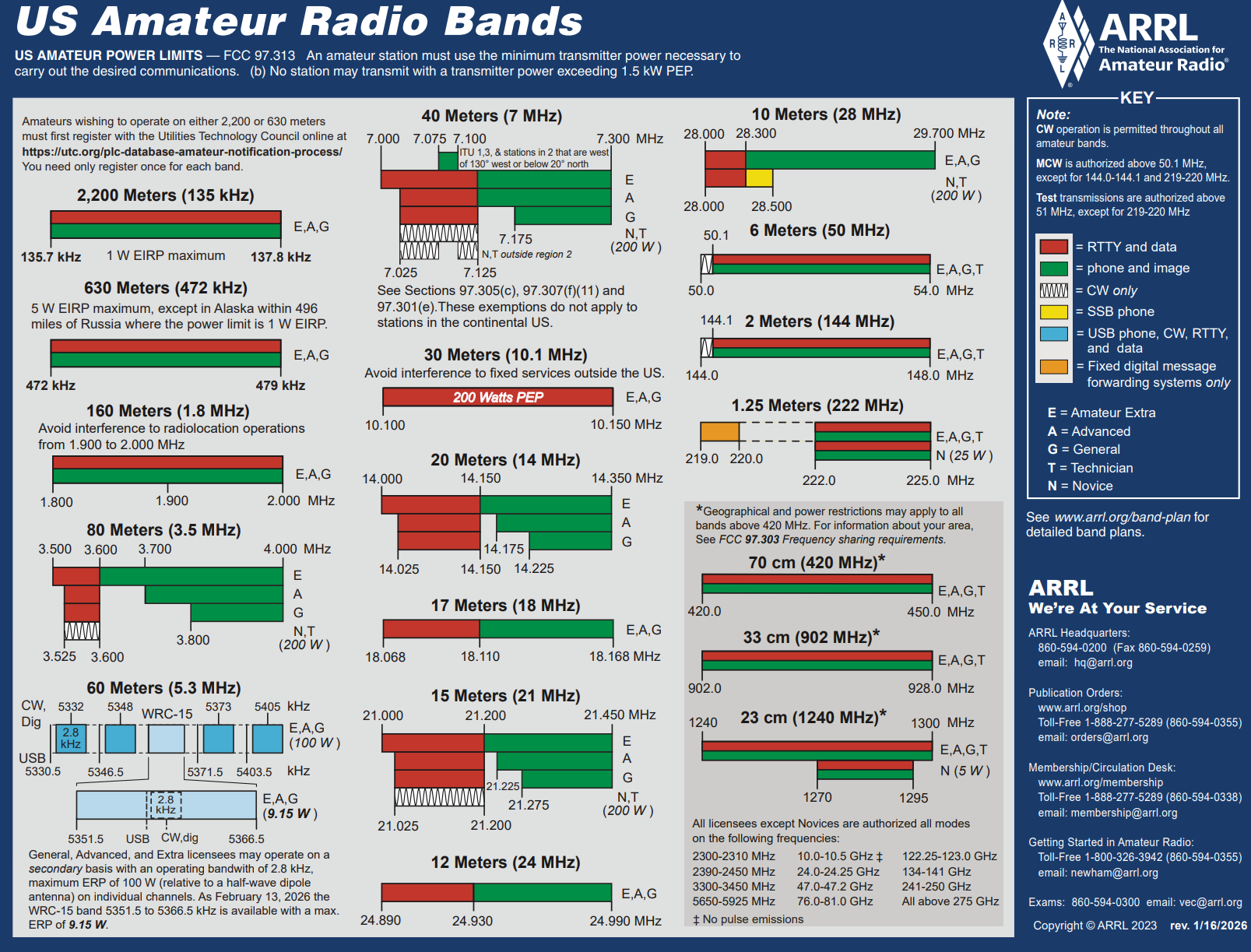
The ARRL band plan is a PDF you squint at, scroll through, and eventually give up on. The following is the same information made usable and interactive.

Search a frequency or a mode and jump straight to it. Filter by license class to see exactly where your privileges begin and end. Every segment is color-coded by mode, so you can tell at a glance whether you’re about to call CQ in the middle of the digital watering hole.

Covers 2200 meters through microwave. Works on your phone in the field, on your laptop at the operating desk, and in color-blind-friendly and light modes.

A band plan is a voluntary agreement among operators to keep incompatible modes out of each other’s way. It is not the law, Part 97 is. Always check current FCC rules before transmitting.

SFARC SPECTRUM EXPLORER

A band plan is a voluntary division of a band to avoid interference between incompatible modes.

Where can I operate?
  • CW
  • Phone / SSB / AM
  • Digital / Data
  • FM / Repeater
  • Beacons
  • Satellite / EME
  • ATV / SSTV
  • Experimental
  • Other / Shared
Based on the ARRL Band Plan. Locally coordinated plans always take precedence.


DOWNLOAD

What is Five Nine? (Tile)

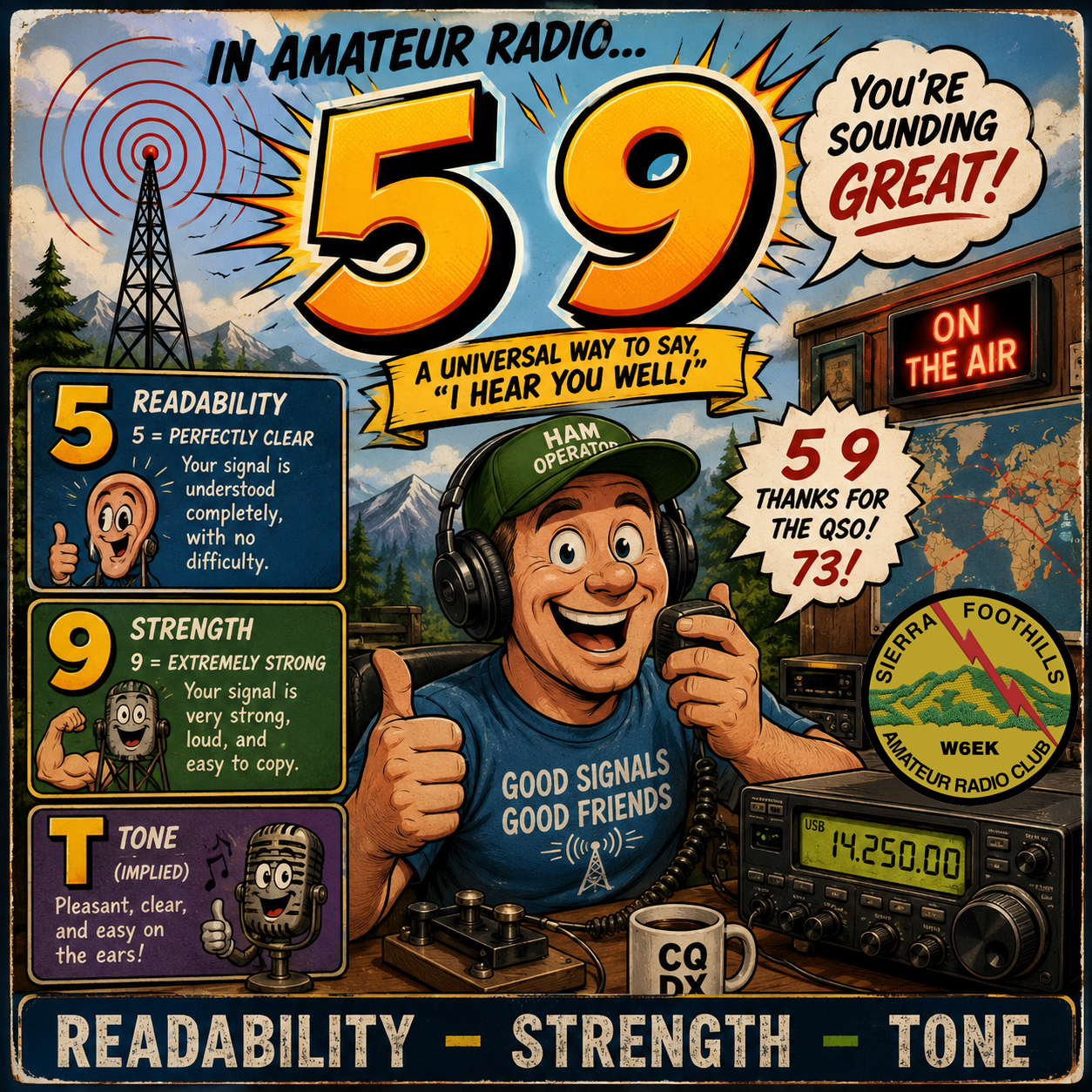
WHAT IS FIVE NINE (5 9) AND WHAT DOES IT MEAN?

The R-S-T system is used by amateur radio operators, shortwave listeners, and other radio hobbyists to exchange information about the quality of a radio signal being received. The code is a three-digit number, with one digit each for conveying an assessment of the signal’s readability, strength, and tone. The code was developed in 1934 by amateur radio operator Arthur W. Braaten, W2BSR.

The R stands for “Readability“. Readability is a qualitative assessment of how easy or difficult it is to correctly copy the information being sent during the transmission. In a Morse code telegraphy transmission, readability refers to how easy or difficult it is to distinguish each of the characters in the text of the message being sent; in a voice transmission, readability refers to how easy or difficult it is for each spoken word to be understood correctly. “Readability” is measured on a scale of 1 to 5.

The S stands for “Strength“. Strength is an assessment of how powerful the received signal is at the receiving location. Although an accurate signal strength meter can determine a quantitative value for signal strength, in practice, this portion of the RST code is a qualitative assessment, often made based on the S meter of the radio receiver at the location of signal reception. “Strength” is measured on a scale of 1 to 9.

The T stands for “Tone” and is measured on a scale of 1 to 9. Tone only pertains to Morse code and other digital transmission modes and is therefore omitted during voice operations. With modern technology, imperfections in the quality of transmitters’ digital modulation severe enough to be detected by human ears are rare.

Readability

Strength

5. Perfectly readable

9. Extremely strong signals

4. Readable with practically no difficulty

8. Strong signals

3. Readable with considerable difficulty

7. Moderately strong signals

2. Barely readable, occasional words distinguishable

6. Good signals

1. Unreadable

5. Fairly good signals

4. Fair signals

3. Weak signals

2. Very weak signals

1. Faint—signals barely perceptible

Understanding RFI (Tile)

Understanding RFI

RFI happens when electromagnetic signals from one device disrupt the normal operation of another. These signals can be intentional (like a radio transmitter) or accidental (like electrical noise).

Common Sources Include:
– Cell Phones & Wi-Fi Routers
– Power Lines & Electrical Motors
– LED Lights & Switching Power Supplies
– Computers, Monitors, USB cables
– Vehicle Ignition Systems
– Radio/TV Transmitters
– EV Car Chargers
– Solar Inverters

Interference occurs when unwanted radio-frequency signals disrupt the use of your television, radio, or cordless telephone. Interference may prevent reception altogether, cause only a temporary loss of signal, or affect the quality of the sound or picture produced by your equipment.

How Can I Reduce It?
– Shielding (metal enclosures, braided cables)
– Filtering (ferrite beads, line filters)
– Better grounding
– Physical separation between noisy and sensitive devices
– Good cable routing and design

Sometimes you can take all of the above steps and STILL have RFI issues.  When in doubt, check out additional resources from the American Radio Relay League or file a report with the Federal Communications Commission (FCC).