
All posts by Smitty (WB1G)

File Library (Members) (Page)

;

Got a diagram, chart, documentation, or any other file to share with other SFARC members? If you wish to upload a file(s), click the UPLOAD FILES button.

;

BACK TO MAIN LIBRARY

1
TypeNameSize
Thumb members/Graphics-Archive/ Graphics-Archive

Open 192.41 MB 2025-08-13 August 13, 2025 2025-08-13 August 13, 2025
88 Items
192.41 MB
Thumb members/Hamfest-Private-Files/ Hamfest-Private-Files

Open 52.18 MB 2025-08-12 August 12, 2025 2023-04-04 April 4, 2023
55 Items
52.18 MB
Thumb members/Newsletter-Materials/ Newsletter-Materials

Open 9.78 MB 2025-08-13 August 13, 2025 2024-08-13 August 13, 2024
28 Items
9.78 MB
Thumb members/Repeater-Lease/ Repeater-Lease

Open 3.51 MB 2025-08-11 August 11, 2025 2025-08-11 August 11, 2025
1 Items
3.51 MB
Thumb members/Treasurer-Reports/ Treasurer-Reports

Open 61.11 MB 2025-08-11 August 11, 2025 2025-09-03 September 3, 2025
546 Items
61.11 MB

0

782b29a339

File Library (Page)

SFARC FILE LIBRARY


;

Got a diagram, chart, documentation, or any other file to share with other SFARC members? If you wish to upload a file(s), click the UPLOAD FILES button.

;

Reserved for SFARC Members.

** Password Required **

1

0

782b29a339

Photo Gallery Uploader (Page)

Photo Gallery (Page)

Is Broadcast Radio Dead (Tile)

Is Broadcast Radio Dead?

It’s complicated, and it starts with relevance.
by Smitty (WB1G)

Having spent 15 years working in radio, in front of and behind the microphone, I am passionate about this topic. So the best place to start is whether radio is still relevant. The simple answer is yes, but limited to a demographic that is aging out. The primary radio advertising “buying demo” is adults 25–54. As Gen Xers get older and head into retirement, spending becomes more calculated. Broadcast radio remains dominant in vehicles, with AM/FM representing over 70% of ad-supported in-car listening among the upper end of the demographic. Radio remains a strong reach medium, but it is no longer the center of people’s audio lives. The key is the “upper end of the demographic”.

What’s In A Name?
Ask your kids or grandkids what their favorite radio station is and who their favorite DJ is. Among ages 13–24, over-the-air radio accounts for roughly 16% of total audio time. Only 10% of ages 13–17 and 5% of ages 18–24 identify AM/FM as their primary source for discovering music (from Radio World and Radio Ink).
Plenty of under-25s “hear radio”, often in a parent’s car, workplace, or shared setting, but that doesn’t mean they intentionally selected the station, know its call letters or frequency, or could name it when asked. In advertisers’ eyes, that is not good.

What about AM radio?
According to Edison Research, AM radio is in a substantially weaker position with people under 25 than FM radio. Current national studies generally combine AM and FM, so there is no credible published percentage showing how many under-25s can name an AM station. AM isn’t dead as a distribution system, but among younger listeners it has a serious brand awareness and intentional-use problem that makes ad monetization challenging beyond radio’s broader challenge. Large antenna systems and towers require substantial land, ground radials, and specialized maintenance, which makes AM cost prohibitive in many markets. A National Alliance of State Broadcasters Associations survey of more than 1,000 AM stations found that over 70% of AM radio stations on the air today have an FM simulcast.


Looking into the crystal ball, how much time do we have left? In the United States, FM radio likely has at least another 20 years as a meaningful broadcast service; however, that doesn’t indicate profitability. Among existing radio fans surveyed by Jacobs Media, broadcast delivery fell from 85% of station listening in 2013 to 54% in 2026. Digital delivery rose from 14% to 44%; among Gen Z, digital has already slightly passed broadcast. The greater near-term risk isn’t that the FM band is switched off. It’s that individual stations become economically unsustainable, further consolidate, reduce local programming or operate mainly as automated extensions of digital brands. To be frank, this has already been happening for the last 20 years.

So where does that leave us?
I’m sorry to say, when Gen Xers and early Millennials age out, broadcast radio will become more niche and background noise.

Placer County ARES (Page)

PLACER COUNTY ARES HAS A NEW WEBSITE

CLICK HERE

The Placer County Amateur Radio Emergency Service (ARES) consists of licensed amateurs who have voluntarily registered their qualifications and equipment for communications duty in the public service when disaster strikes.

The Placer County ARES net is on the 3rd Sunday of the month, starting at 1930 (7:30 PM) PT on the W6EK 2M Repeater.

Everyone is invited to check-in. You do not need to be an SFARC member to participate.

Groups.io (Page)

WHAT IS GROUPS.IO?

Groups.io provides an expansive set of web-based group communication tools, including a calendar, wiki, files, and a forum for chatting.

SFARC uses Groups.io to collaborate, post items for sale, share stories, and work on ham-related projects.
Click here to login to Groups.io

Connect With SFARC (Page)

There are many ways to connect with the Sierra Foothills Amateur Radio Club.

Join the FRIENDS OF SFARC mailing list.  This allows you to keep track of what the club is doing and decide whether or not you want to become a member.  The vast majority of events hosted by SFARC are open to all.  CLICK HERE to enroll.

CLUB MEETING is a great place to interact with us, meet friends or make new ones, learn about other activities, and ask questions 1-on-1.

Like or follow SFARC on one of the five major SOCIAL MEDIA platforms. You don’t have to “be on Facebook” to take part. We’re VERY active on Instagram, Twitter, LinkedIn, and YouTube.

Collaborate with SFARC on GROUPS.IO.  SFARC uses Groups.io to collaborate, post items for sale, share stories, and ham-related projects.

Join a club meeting on ZOOM.  Can’t make it to one of our meetings in person? No problem!  SFARC provides a robust and interactive experience for all club meetings.

Join us at a CLUB EVENT OR ACTIVITY.  You don’t need to be a member to join us for the numerous events and activities we take part in.  Don’t be a stranger, come and say hi.

ARRL (Page)

WHAT IS THE ARRL?

The ARRL, the National Association for Amateur Radio (ARRL) is the national association for amateur radio (ham radio) operators in the United States, founded in 1914. The ARRL recognizes SFARC as a special service club for our commitment to the local community and emergency

Small ARRL LogoIts main roles include:

  • Advocacy & representation for amateur radio with the FCC and international regulators
  • Education & licensing support, including study materials and exams
  • Operating activities like contests, awards, and emergency communications programs
  • Publications, most notably QST magazine
  • Emergency communications, coordinating volunteer hams during disasters via ARES (Amateur Radio Emergency Service)

From The Desk of the ARRL

09/18/2026The ARRL Solar UpdateSolar flare activity is expected to remain at very low levels, with achance for isolated C-class flares through September 19, according toNOAA's Space Weather Prediction Center (SWPC). Solar wind speed wassteady near 530 km/s, and negative polarity CH HSS (coronal holehigh-speed stream) effects are… READ MORE
09/17/2026Get Ready for Jamboree on the Air READ MORE
09/16/2026Contest University Celebrates 100 Years of YagisThe Yagi-Uda beam antenna was invented 100 years ago, in 1926, and Contest University (CTU) is celebrating its centennial with a live Zoom webinar this Saturday, September 19, 2026, at 1600 UTC (noon Eastern). The free webinar, titled “The Yagi Turns 100,” will be available online at https://w3lif.o… READ MORE
09/14/2026The ARRL Solar UpdateSolar flare activity was at low levels in the past week withisolated C-class flare activity, according to NOAA’s Space WeatherPrediction Center. The largest flare of the period was a C3.4 onSeptember 8 from otherwise stable Region 4528. Region 4530 developedasymmetric penumbra on both its leading an… READ MORE
09/11/2026Special HAARP Transmission for 9/11To commemorate the 25th anniversary of the September 11, 2001 attacks on the United States, the High-frequency Active Auroral Research Program (HAARP) at the University of Alaska Fairbanks will be making a special transmission on 9.11 MHz at 0030-0035 UTC on September 12, 2026 (8:30-8:35 PM eastern… READ MORE

Check out all the ARRL has to offer by visiting their website @ https://www.arrl.org/ Continue reading ARRL (Page)

Interactive Band Plan (Tile)

INTERACTIVE BAND PLAN

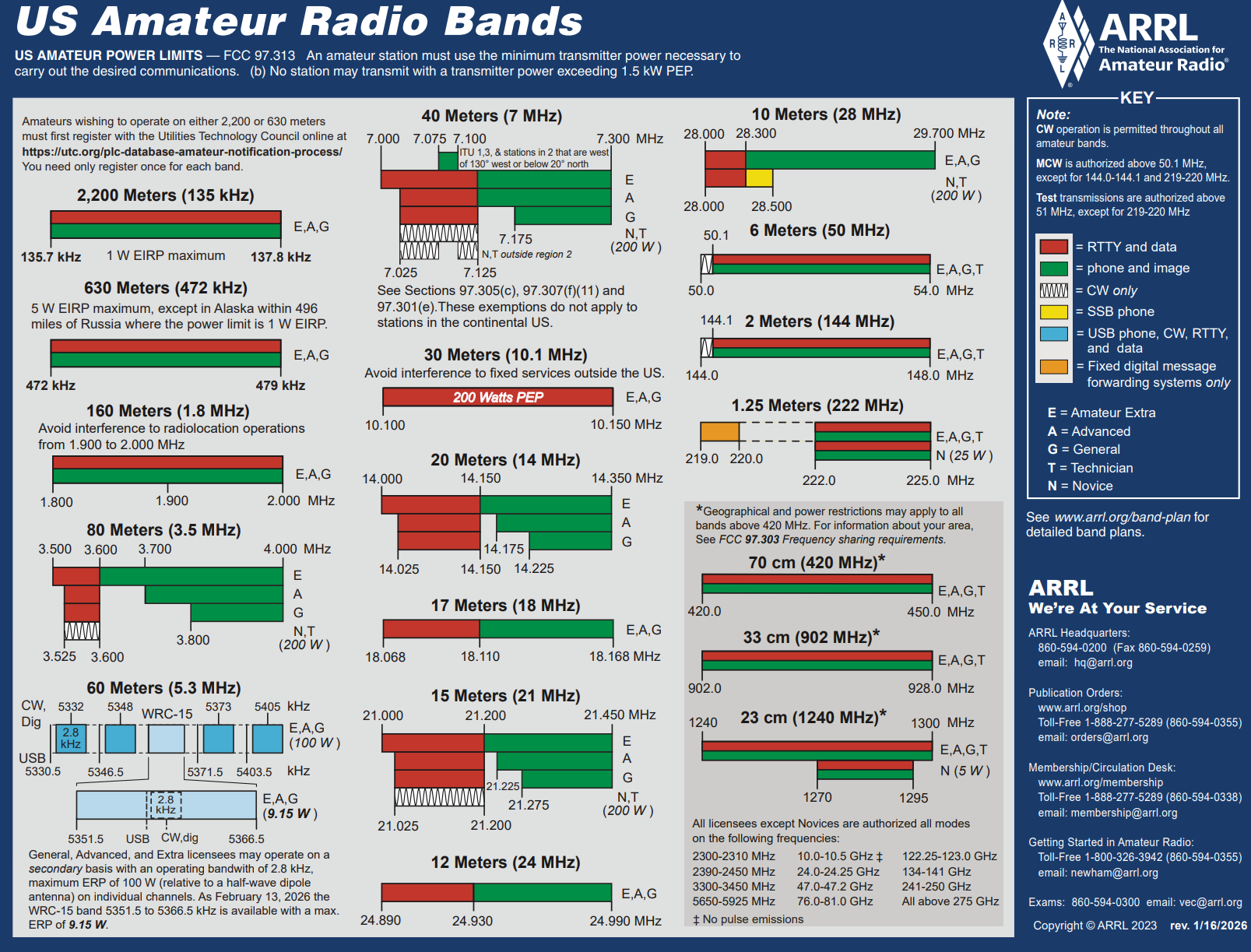
The ARRL band plan is a PDF you squint at, scroll through, and eventually give up on. The following is the same information made usable and interactive.

Search a frequency or a mode and jump straight to it. Filter by license class to see exactly where your privileges begin and end. Every segment is color-coded by mode, so you can tell at a glance whether you’re about to call CQ in the middle of the digital watering hole.

Covers 2200 meters through microwave. Works on your phone in the field, on your laptop at the operating desk, and in color-blind-friendly and light modes.

A band plan is a voluntary agreement among operators to keep incompatible modes out of each other’s way. It is not the law, Part 97 is. Always check current FCC rules before transmitting.

SFARC SPECTRUM EXPLORER

A band plan is a voluntary division of a band to avoid interference between incompatible modes.

Where can I operate?
  • CW
  • Phone / SSB / AM
  • Digital / Data
  • FM / Repeater
  • Beacons
  • Satellite / EME
  • ATV / SSTV
  • Experimental
  • Other / Shared
Based on the ARRL Band Plan. Locally coordinated plans always take precedence.

DOWNLOAD