All posts by Smitty (WB1G)

Leadership Roles | Director(s) (Tile)

Role Description: DIRECTOR(S)

Governance & Stewardship
Directors uphold the club’s bylaws, ensure financial oversight, and protect the organization’s long‑term stability. Their focus is on maintaining compliance, continuity, and strategic awareness.

Support & Representation
Directors provide guidance to officers, evaluate proposals, plan for future needs, and represent member interests. They keep discussions productive, ask informed questions, and help safeguard the club’s reputation.

Operational Contribution
Most directors lead a specific functional area—such as outreach, repeater projects, training, or meeting logistics—to deliver practical value. Their involvement strengthens the club and supports a welcoming, forward‑looking environment.

<< BACK TO LEADERSHIP

Welcome to SFARC (Page)

Main SFARC Club LogoWelcome to the Sierra Foothills Amateur Radio Club (SFARC). SFARC is an ARRL Special Services Club located in the foothills above the Sacramento Valley in Auburn, CA.

A list of current officers, board members, events calendar, and our newsletter can be found at www.w6ek.org.

Get On The Air With SFARC

SFARC has a very active repeater network.  There’s almost always someone to connect with on the air. Need help programming your radio? Contact our “Elmer Team“.

145.430 Mhz, – 600 Khz | CTCSS (PL): 162.2 Hz

Mode: FM Analog

Links: AllStarLink: 51018, Echolink: 4128, and Wires-X: W6EK-2M-ROOM (62545)

223.860 Mhz, –1.6 Mhz | CTCSS (PL): 110.9 Hz

Mode: FM Analog

440.575 Mhz +5 Mhz | CTCSS (PL): 162.2 Hz

Mode: AMS (auto mode select) Analog FM OR C4FM (Digital Fusion) Digital: DG-ID: 00 /

Linked: YSF06040: US-NorCalRptGrp

Location

Frequency / Offset

Name

Elk Grove, CA

444.525 Mhz +5.0

CTCSS (PL) 127.3

K6JWN/R

Galt, CA

443.450 Mhz +5.0

CTCSS (PL) 107.2

K6SAL/R

Georgetown, CA

147.210 Mhz +.600

CTCSS (PL) 100

KK7AIR/R

Lake Tahoe / Mt Rose

443.875 Mhz +5.0

CTCSS (PL) 103.5

K6SAL/R


Ways to connect with SFARC

Join Us In Person for a Club Meeting
This is a great place to interact with us, meet friends or make new ones, learn about other activities, and ask questions 1-on-1. SFARC holds regular club meetings on the Second Friday of each month, at 7:30 PM at the Placer County HHS Conference Center, Cordova Room 500, 1434 B Ave, Auburn, CA 95603

Join Us Online for a Club Meeting
Can’t make it to one of our meetings in person? No problem!  SFARC provides a robust and interactive experience for all club meetings at meeting.w6ek.org

Follow Us On Socialfacebook.w6ek.org / instagram.w6ek.org / x.w6ek.org / linkedin.w6ek.org 
Like or follow SFARC on one of the five major SOCIAL MEDIA platforms. You don’t have to “be on Facebook” to take part. We’re VERY active on Instagram, Twitter, LinkedIn, and YouTube.

Collaborate With Us On Groups.iogroupsio.w6ek.org 
SFARC uses Groups.io to collaborate, post items for sale, share stories, and ham-related projects.

Join Us At A Club Event or Activity
You don’t need to be a member to join us for the numerous events and activities we take part in.  Don’t be a stranger, come and say hi.

Annual Dues and ARRL Affiliation
Annual dues for full membership are $22/year, with an associate membership available for spouse, significant other, or other family members for $7/year. Membership in the club entitles you Groups.io access and all activities and functions – most of which are free to members (examples include the annual club picnic and ARRL Field Day).

Board Meetings
Board meetings are held the Thursday before the general meeting each month and are held on Zoom (meeting.w6ek.org) at 6:00 PM PT.  All members in good standing are invited to board meetings.

Nets
The club meets on the W6EK 2-meter repeater every Thursday at 7:30 PM. We also host some popular worldwide nets, including the Coffee Break Net (daily), Elmer Net (Monthly, every 1st and 3rd Wednesday), and the All-Nodes Net (every Monday at 6:00 PM PT). More information about our nets can be found at https://www.w6ek.org/repeaters/nets 

Thank you for becoming part of the Sierra Foothills Amateur Radio Club. We look forward to seeing you at a meeting or event soon.

73,


Mark Koehler (W2MWK) | President

Sierra Foothills Amateur Radio Club
president@w6ek.org

DOWNLOAD THE WELCOME LETTER
Club Meetings – Online (Page)

CLUB MEETINGS – VIRTUAL

A pro tip before you join the meeting: if you aren’t talking, go ahead and mute your microphone. And “putting your best foot forward” often means putting on pants and checking your camera often.  Ready to go?  Click JOIN THE MEETING below.  While you shouldn’t be prompted for it, the Zoom meeting information is below with an alternate way to join.Click here to enter the SFARC Zoom room.If Prompted:
Meeting ID: 962 6167 5605
Passcode: SFARC
You can also call in using only your telephone.
+16699009128,96261675605# *454729# US (San Jose)
+13462487799,96261675605# *454729# US (Houston)

Field Day | About (Page)

What Is Field Day?

Field Day is a picnic, a campout, practice for emergencies, an informal contest and, most of all, FUN!

ARRL Field Day is the single most popular on-the-air event held annually in the US and Canada. On the fourth weekend of June of each year, more than 35,000 radio amateurs gather with their clubs, groups or simply with friends to operate from remote locations.

It is a time when many aspects of Amateur Radio come together to highlight our many roles. While some will treat it as a contest, other groups use the opportunity to practice their emergency response capabilities. It is an excellent opportunity to demonstrate Amateur Radio to the organizations that Amateur Radio might serve in an emergency, as well as the general public. For many clubs, ARRL Field Day is one of the highlights of their annual calendar.

The contest part is simply to contact as many other stations as possible and to learn to operate our radio gear in abnormal situations and less than optimal conditions.

We use these same skills when we help with events such as marathons and bike-a-thons; fund-raisers such as walka- thons; celebrations such as parades; and exhibits at fairs, malls and museums — these are all large, preplanned, non-emergency activities.

But despite the development of very complex, modern communications systems — or maybe because they ARE so complex — ham radio has been called into action again and again to provide communications in crises when it really matters. Amateur Radio people (also called “hams”) are well known for our communications support in real disaster and post-disaster situations.
BACK TO MAIN MENU

What is the ARRL?

The American Radio Relay League is the 150,000+ member national association for Amateur Radio in the USA. ARRL is the primary source of information about what is going on in ham radio. It provides books, news, support and information for individuals and clubs, special events, continuing education classes and other benefits for its members.
BACK TO MAIN MENU

What is Amateur Radio?

Often called “ham radio,” the Amateur Radio Service has been around for a century. In that time, it’s grown into a worldwide community of licensed operators using the airwaves with every conceivable means of communications technology. Its people range in age from youngsters to grandparents. Even rocket scientists and a rock star or two are in the ham ranks. Most, however, are just normal folks like you and me who enjoy learning and being able to transmit voice, data and pictures through the air to unusual places, both near and far, without depending on commercial systems.

The Amateur Radio frequencies are the last remaining place in the usable radio spectrum where you as an individual can develop and experiment with wireless communications. Hams not only can make and modify their equipment, but can create whole new ways to do things.

Field Day | Camping Rules (Page)

CAMPING RULES

THE BASICS:
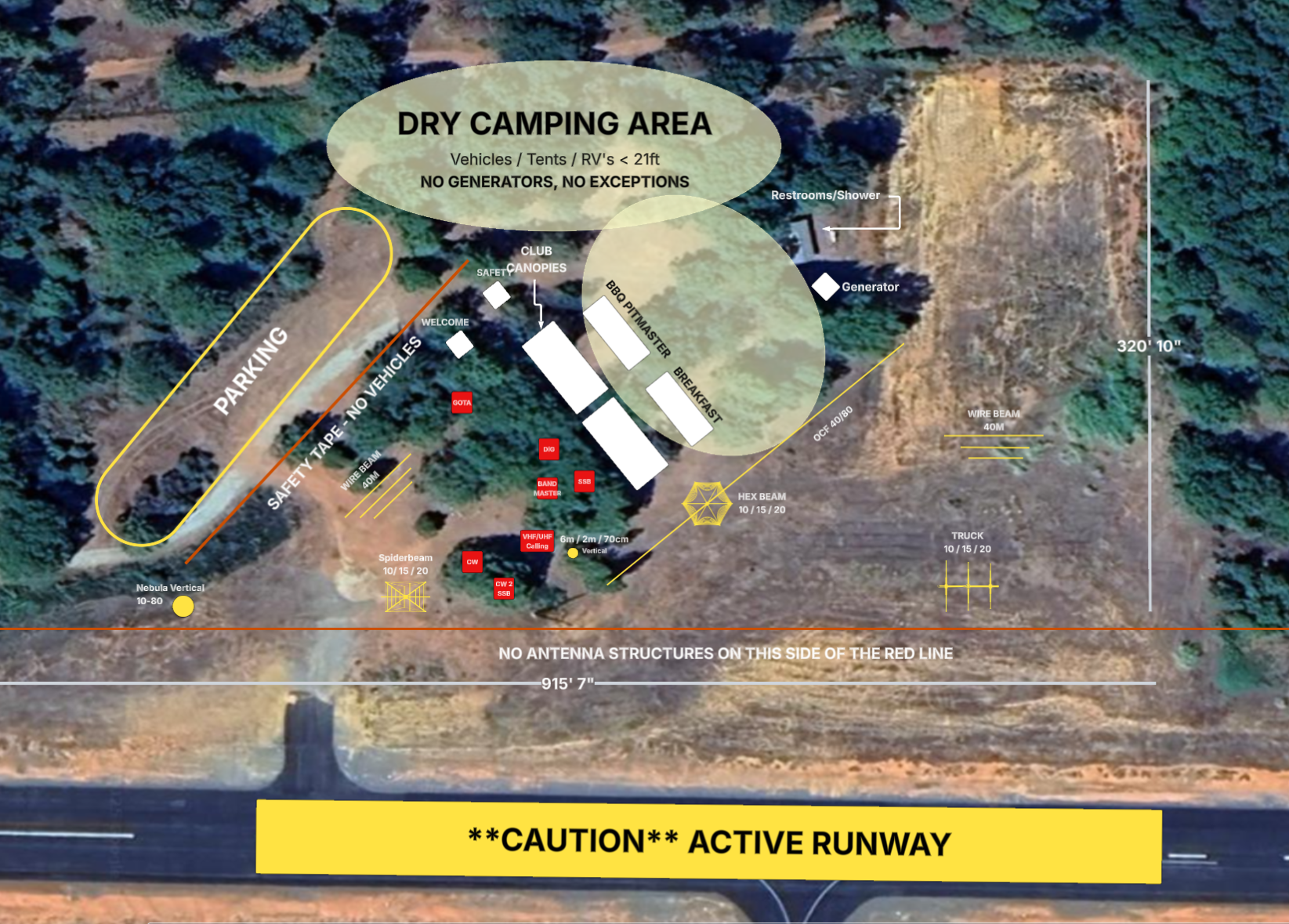
DRY CAMPING — No Electricity, no sewer/dump access, and no dedicated water bibs are available.
– All campers will NOT be permitted to plug into the club’s main generator, NO EXCEPTIONS!
– No Campfires, NO EXCEPTIONS! (including propane)
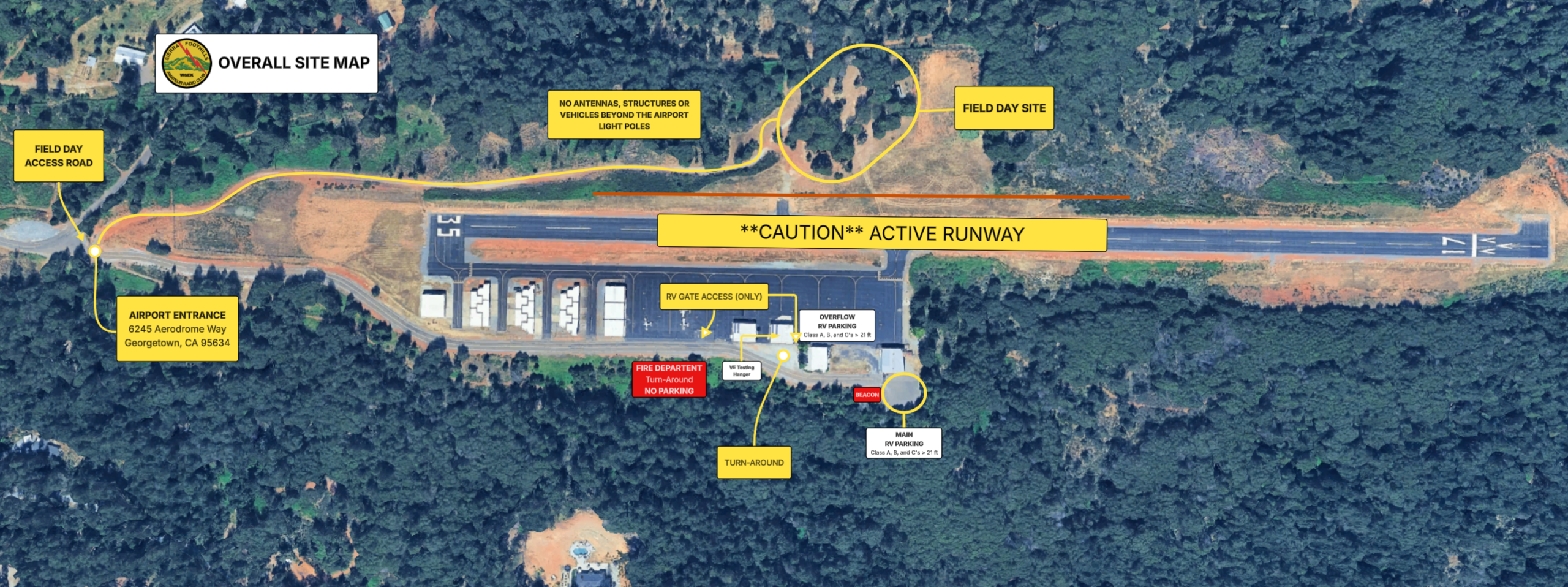
All visitors, please use the west side (campground) access road. No public access from east side and crossing the active runway.
– Campers must agree to the follow rules specific to their camp area (below).

TENTS AND RVS (WEST SIDE):
– Tent, hammock, in-vehicle, and RV’s under 21ft, will be setup on the west side of the runway. This area has access to potable water, flushing toilets, cold showers, and sinks.
– No personal generators are permitted on the west side of the runway, NO EXCEPTIONS.

LARGE RVS 21+FT (EAST SIDE):
– Larger RVs be able to park in designated areas on the east side of the runway.
– Those camping on the east side of the runway are allowed the use of personal power stations and generators.
– This area has access to flushing toilets and sinks.

Field Day | Contest Results (Page)

ARRL Field Day 2026 · Club Results
SFARC Field Day 2026
Five transmitters plus a GOTA station, a field full of visitors, and 1,637 contacts in the log. Here is how the weekend went.
1,637
Total QSOs
120+
Visitors to the site
5 + GOTA
Transmitters
Bonus points: We captured most of the available bonus points this year. The one that got away — the satellite QSO. Something to plan for in 2027.

The Log

Contacts by band and mode

Band CW Digital Phone
QSOs Power QSOs Power QSOs Power
160m
80m 22 100 W
40m 223 100 W
20m TOP BAND 641 100 W 238 100 W 186 100 W
15m 414 100 W 175 100 W
10m
6m 19 50 W
2m 8 50 W
222 / 432 / Other No contacts logged
Satellite The one bonus we missed — next year

Every contact was made at 100 watts or less, with 6m and 2m running just 50 watts. No amplifiers, no commercial power — just wire, antennas and skill.

Mode Split

Where the contacts came from

CW Digital Phone
1,300
CW contacts
Roughly two out of every three
432
Digital contacts
Including 19 on 6m
194
Phone contacts
Plus 113 more on GOTA
Get On The Air
113 contacts. 12 operators. One microphone.
The GOTA station is where Field Day earns its keep. Newcomers, family members and freshly licensed hams took the mic and worked the country — four of these operators do not have a callsign yet.
Operator Call Phone QSOs
Maxim Graff KO6NEZ 68
Natali Woodmansee WB6NAT 11
Jeremy Graff KO6KUL 9
Jack Stenhouse not yet licensed 5
Corde Wagner K6LDA 3
Andrea Nowak KO6NMP 3
Duane Chorty KO6NYI 3
Andrew Myers KO6NYJ 3
Lan Graff KO6MWK 3
Chase Galland not yet licensed 3
Eumin Son not yet licensed 1
Tracy Gallard not yet licensed 1
GOTA Total 113

By The Numbers

A few things worth bragging about

1 CONTACT EVERY 53 SECONDS
Averaged across the 24-hour operating period, the club logged roughly 68 QSOs an hour.
20M FOR THE WIN
1,065 contacts across CW, digital and phone — more than half of everything in the log.
THE CW TEAM MAKING IT HAPPEN
1,300 CW contacts — roughly two out of every three QSOs came off a paddle.
A BUSTLING CAMPGROUND
More than 120 people came through the site over the weekend — the best kind of crowded.
4 FIRST-TIME OPERATORS
Four of the twelve GOTA operators do not hold a callsign yet — and they still put contacts in the log.
Thank you to everyone who showed up
Setup crews, operators, loggers, cooks, antenna raisers and the folks who just stopped by to see what all the wire was for. See you in the field next June — and somebody bring a satellite rig.

Band and mode totals reflect the contacts logged at the five main transmitters. GOTA totals are listed separately. Official submitted total: 1,637 QSOs.

Field Day | Debrief (Page)

FIELD DAY DEBRIEF (2026)

Key Outcomes
The club held a post-Field Day debrief covering operations, logistics, food, and planning improvements. Overall feedback was positive — participants praised organization, hospitality, the Georgetown venue, and the GOTA station. Key gaps identified include insufficient band captain coverage, no assigned SSB station owner, weak volunteer pre-commitment, and late outreach to youth/scouting groups. A comprehensive checklist and station equipment list are being developed for next year.

Decisions Made
• Sign-up sheets will return at operating stations (not pre-event); dry-erase board also proposed for GOTA queue management.
• Band captain role expanded to 2–3 people on rotating shifts, with Dave remaining team lead.
• All HF stations to be configured multi-mode (voice + digital + CW) to adapt to band conditions.
• Antenna site map to be created, laminated (11×14), and posted at the band captain station with patch panel port labels.
• GOTA logging sheets pre-printed and placed at the station during setup — not left to the station chair.
• Winlink messages to be CC’d to the scoring aggregator (Dennis) going forward.
• Youth/scouting outreach must begin by late December–January; outbound chair owns this task if no Field Day chair is yet assigned.

Completed / What Worked
• GOTA station was highly active, well-received; multiple success stories including first-time operators and family participants.
• Trailer used for first time — setup, cleanup, and loading were significantly smoother.
• FT8 + GOTA placed side-by-side simplified power runs and infrastructure.
• Brian’s antenna walk-and-talk sessions (×2) were well-received as educational content.
• Electronic check-in system praised; confirmed as club-owned asset (Brian is caretaker, donated printer).
• Handicap parking added with signage — appreciated by senior members.
• Mac and cheese and new menu items were hits; total food cost ~$600, overall event cost $1,000 with $491 in donations.

Blockers / Issues Identified
• Attendance undercount: Official log showed 103 (1 dupe); Brian estimated 165–170 actual attendees across all 3 days.
• Network/logging setup disrupted by unauthorized changes; Dennis frustrated by people bypassing him to modify the system.
• SSB station had no assigned owner, leading to it being underutilized overnight.
• Band master gap: No coverage after ~midnight; operators unsure how to switch bands or reroute antennas.
• GOTA/CW interference: GOTA antenna initially placed on 40m directly over CW station; partially resolved by moving it.
• Center social circle noise was disruptive to GOTA station voice operations.
• Bathroom condition: Both restrooms were severely misused on Saturday and required hosing out; had not been an issue in prior years.
• 80m doublet antenna was never connected to the patch panel and went unused.

Pending Confirmation
• Whether Frank is a viable candidate to shadow/replace Dennis on logging/networking next year.
• Optimal antenna placement for CW station vs. GOTA to reduce RF interference.
• Who designs the patch panel block diagram — band captain team vs. site infrastructure role.
• Whether numbered plates (pre-marked for head count) are commercially available.

Action Items
• Smitty: Finalize station equipment checklists; add band captain committee (min. 3 people) and youth outreach deadline (Dec–Jan) to master checklist.
• Smitty: Blow up and laminate antenna site map with patch panel port labels for band captain station.
• Smitty: Send food service checklist to Garrett for review while details are fresh.
• Tom: Submit GOTA paper logs to Dennis.
• WA8MPA (Jim): Create block diagram of network/patch panel layout for lamination and use at band captain station.
• WA8MPA (Jim): Continue periodic maintenance of 8 field day computers (charge, update software) throughout the year.
• SFARC (Mark): Add soap/hand sanitizer to shopping list; purchase squeegee for bathroom kit.
• Smitty / Mark: Thank Scott and Gary formally post-event; add to annual checklist.
• Brian: GPS dongles (×2) already donated to club and handed to Dennis — no further action needed.

All chairs: Identify Field Day chair early (not waiting until April); pre-grease key early-lead-time tasks before year-end.