Somewhere above your head, right now, there’s a satellite you could talk through. There’s a balloon sending back weather data. There’s a stranger in Japan who’d be delighted to hear from you.
Amateur radio — ham radio — is the hobby that gets you there. You build the gear, you make the contact, you keep talking when the internet quits. No subscription, no algorithm, no waiting for permission. Just you, an antenna, and everything the sky will carry.
Choosing the right RF connector matters more than it looks. The wrong choice can add loss, raise SWR, let water into your feedline, or simply fail to mate with your gear. This guide compares two of the most common coaxial connectors in amateur and commercial radio — the PL-259 (UHF) and the N Type — and then summarises the other connectors you are most likely to meet: SMA, SMB, MMCX, MCX, TNC and BNC.
PL-259 vs. N Type at a glance
Property
PL-259 (UHF)
N Type
Coupling
Threaded (5/8″-24)
Threaded (5/8″-24), precision interface
Impedance
Not a true constant-impedance design (nominally 50Ω)
Constant 50Ω (75Ω version also made)
Practical frequency range
HF/VHF, generally to ~300 MHz
DC to 11 GHz (precision versions to 18 GHz)
Weatherproofing
Not weatherproof on its own
Weatherproof when correctly mated (gasket/O-ring)
Power handling
High at HF/VHF; robust body
High, with better consistency at UHF and above
Cost & assembly
Cheap, easy to solder, very forgiving
Dearer, more parts, needs careful assembly
Typical use
HF/VHF ham rigs, CB, antenna tuners
UHF/microwave antennas, Wi-Fi, cellular, test gear
PL-259 (the “UHF” connector)
Despite the name, the PL-259 is best thought of as an HF and VHF connector. It dates from the 1930s, when “UHF” meant anything above about 30 MHz. The plug is the PL-259 and the matching socket is the SO-239 (the “PL” and “SO” come from old Signal Corps nomenclature for plug and socket).
It is not a true constant-impedance connector — there is a noticeable impedance discontinuity through the joint — so performance falls away as you climb in frequency. Its strengths are that it is inexpensive, mechanically tough, easy to solder onto thick coax like RG-8 or RG-213, and almost universal on HF and VHF amateur equipment.
Rule of thumb: fine to about 300 MHz; above that, expect rising SWR and use something better.
N Type
The N Type was developed at Bell Labs in the 1940s by Paul Neill (the “N” is for Neill). Unlike the PL-259 it is a genuine 50Ω constant-impedance connector, which makes it well behaved all the way up to 11 GHz, and to 18 GHz in precision versions. Properly mated it is weatherproof, which is why it is the default choice for mast-mounted antennas, Wi-Fi and cellular systems, and microwave links.
The trade-offs are cost, a few more parts to assemble, and the need for more care during termination.
Careful: a 75Ω variant exists for broadcast and CATV work. 50Ω and 75Ω N connectors should not be mated — the differing pin diameters can damage them.
Which should I use?
For HF and VHF on a budget, or to match existing ham gear, the PL-259 is hard to beat. For anything outdoors, anything above ~300 MHz, or where low loss and a clean match matter, choose N Type.
Other common RF connectors
Beyond these two, a handful of smaller connectors turn up constantly in modern radios, antennas, modules and test equipment. The table below summarises the essentials; brief notes follow.
Connector
Coupling
Impedance
Typical max frequency
Where you’ll see it
BNC
Bayonet (quarter-turn)
50Ω & 75Ω
~4 GHz (50Ω)
Test gear, oscilloscopes, video/SDI, older networking
TNC
Threaded
50Ω (75Ω made)
~11 GHz
Threaded “BNC” for vibration/microwave environments
SMA
Threaded (1/4″-36)
50Ω (75Ω rare)
18 GHz (to 26.5 GHz)
Wi-Fi, GPS, handheld antennas, RF modules, test gear
SMB
Snap-on (push)
50Ω & 75Ω
~4 GHz
Tight spaces needing quick, repeated connections
MCX
Snap-on (push)
50Ω (75Ω made)
~6 GHz
GPS, cellular, compact devices (~30% smaller than SMB)
MMCX
Snap-on (push)
50Ω
~6 GHz
Wi-Fi/M.2 cards, tiny antennas, IEMs — smaller than MCX
Quick notes
BNC
A fast bayonet lock that is the workhorse of the test bench. The 50Ω type is for RF; the 75Ω type for video. Convenient but not for high microwave frequencies.
TNC
Essentially a threaded BNC. The screw coupling makes it far more reliable under vibration and pushes the usable range up to around 11 GHz.
SMA
The small threaded connector you find on most Wi-Fi and GPS antennas and on countless RF modules. Excellent to 18 GHz, but the threads have a limited number of mating cycles, so don’t treat it as a frequent connect/disconnect joint. Watch out for RP-SMA (reverse-polarity), which is common on consumer Wi-Fi gear and will not mate with standard SMA.
SMB
A push-on snap fit that is quicker than SMA in cramped assemblies, at the cost of a lower frequency ceiling.
MCX / MMCX
Progressively smaller snap-on connectors for space-constrained devices such as GPS modules, laptop wireless cards and compact antennas. MMCX adds a little rotational freedom, handy for routing thin cables.
A note on the names: several of these share a heritage. N is for Neill, BNC is Bayonet Neill–Concelman, and TNC is Threaded Neill–Concelman — so the B and T simply tell you how the connector locks.
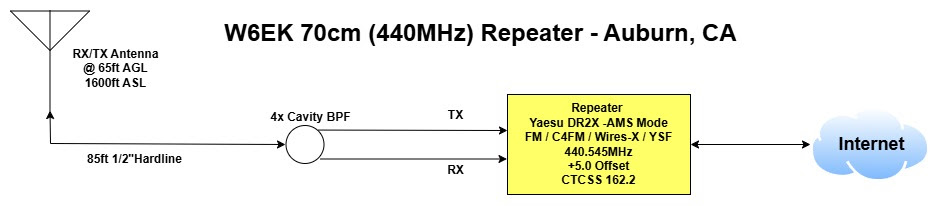
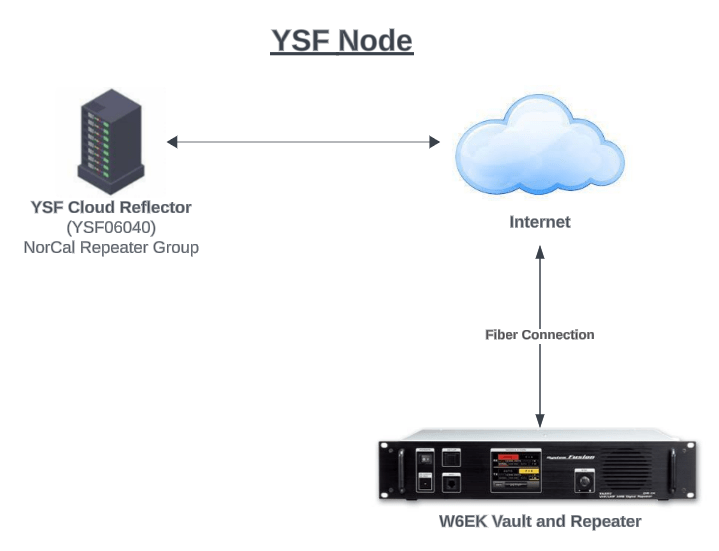
The W6EK 70cm (440) repeater is a Yaesu DR2X repeater installed in 2019. Coordinated with the NARRC on 440.575MHz, + 5 offset, CTCSS 162.2, operating in AMS mode providing both C4FM and FM modes at 40 watts with coverage of the greater Auburn and Eastern Sacramento, California region.
In C4FM digital mode, local RF coverage is complimented by a Wires-X connection to the NorCal Repeater Group #43847 and bridged to the YSF node US-NorCalRptGrp #YSF06040 hosted on a remote server. The default C3FM connection is linked to repeaters located in Galt, Elk Grove, Georgetown and Mt. Rose (serving Lake Tahoe, Truckee and the greater Reno region).
The repeater is capable of operating in either analog FM or digital C4FM modes (Yaesu AMS). Analog FM users will hear a digital hash sound during C4FM digital transmissions unless the analog FM RX Squelch is set to CTCSS 162.2. If FM mode is used to access the repeater, the transmission will only be heard locally from the W6EK 70cm RF transmitter. FM mode transmissions will not be heard on the NorCal Repeater Group Wires-X repeaters or by YSF nodes.
Wires-X Inbound Connect to the W6EK 70cm repeater via any Wires-X enabled repeater, or directly from an internet-connected Yaesu radio using the personal node mode (PDN), The Wires-X room is: NorCal Repeater Group (43847).
Wires-X Outbound
You may redirect the W6EK 70cm repeater to connect via Wires-X mode to any Wires-X-enabled repeater or node. In C4FM digital mode, the Wires-X button on a Yaesu-branded Fusion radio directs the room selection. If there is no activity on the user’s selected node or room for 10 minutes, the Wires-X connection will automatically disconnect and return to the default NorCal Repeater Group room. It is best practice to manually return the repeater back to the default NorCal Repeater Group (43847) room after completing use of the redirected connection.
70cm Repeater YSF
Connect to the 70cm repeater in YSF mode and the NorCal Repeater Group repeaters via any YSF or FCS-enabled repeater, bridge, personal node, or smartphone app. The W6EK 70cm repeater’s YSF node is: US-NorCalRptGrp (YSF06040).
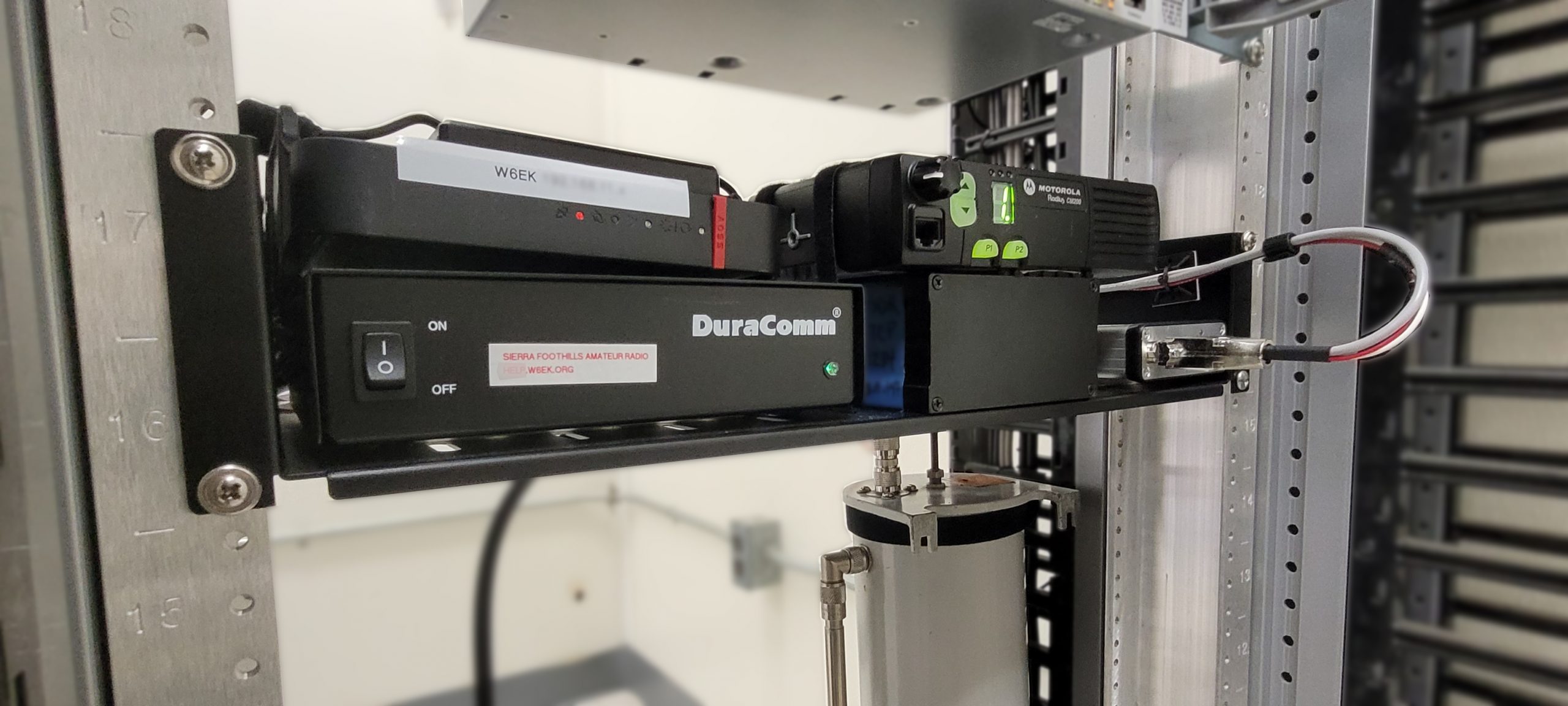
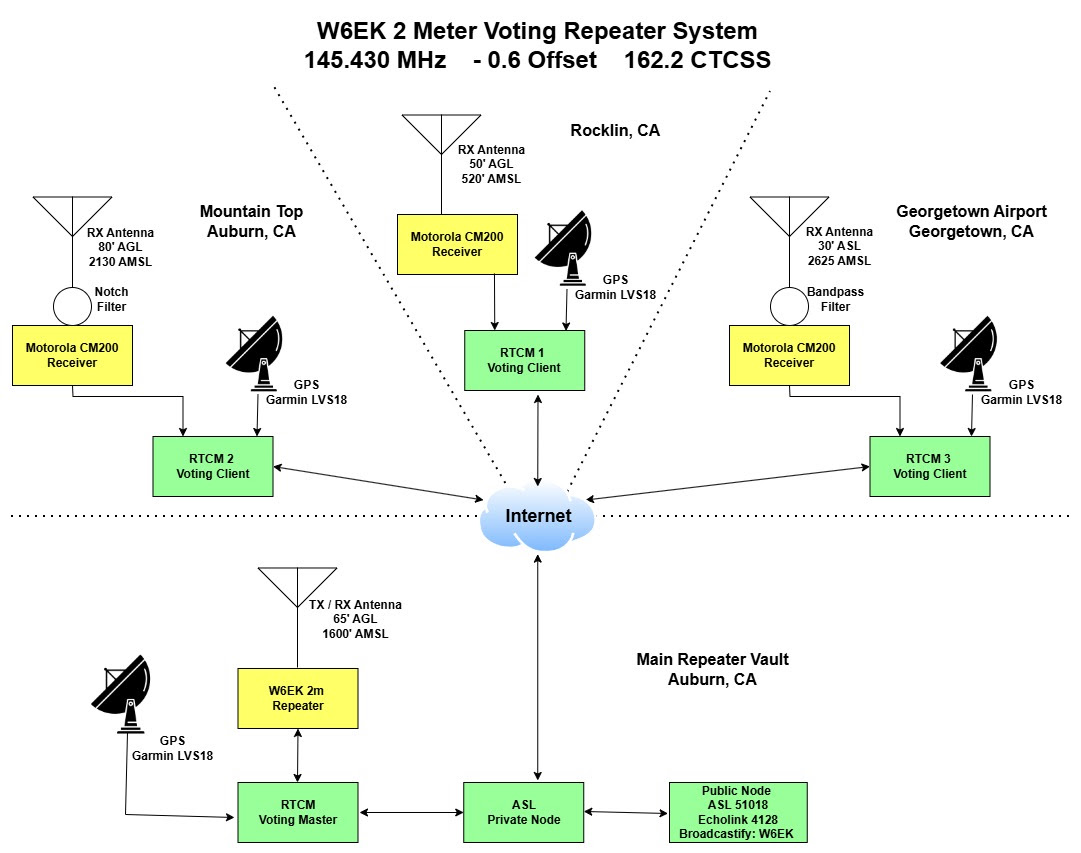
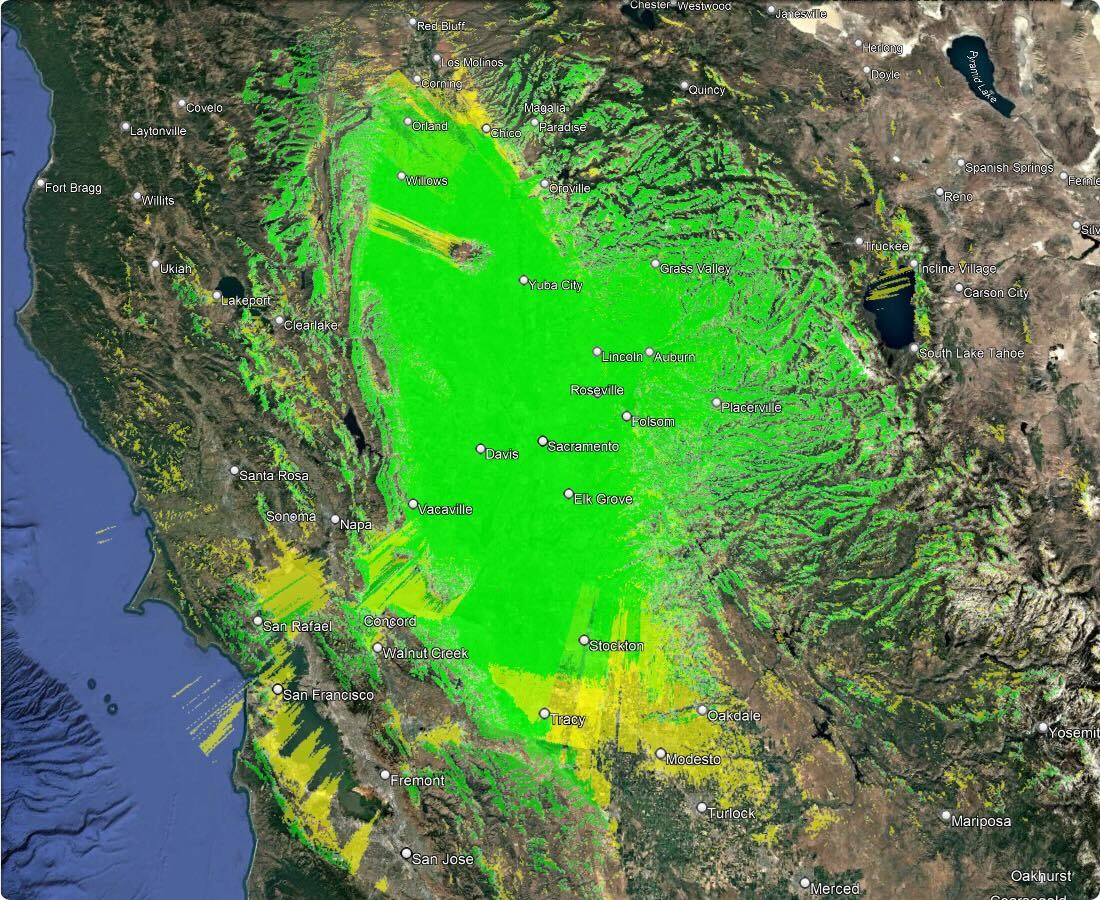
The W6EK 2-meter repeater is a Yaesu DR2X installed in 2020. Coordinated with the NARRC on 145.430 MHz, -.6 offset, CTCSS 162.2, operating in FM mode at 85 watts with coverage of the Western slopes of the Sierra Mountains and across the Sacramento Valley in Northern California.
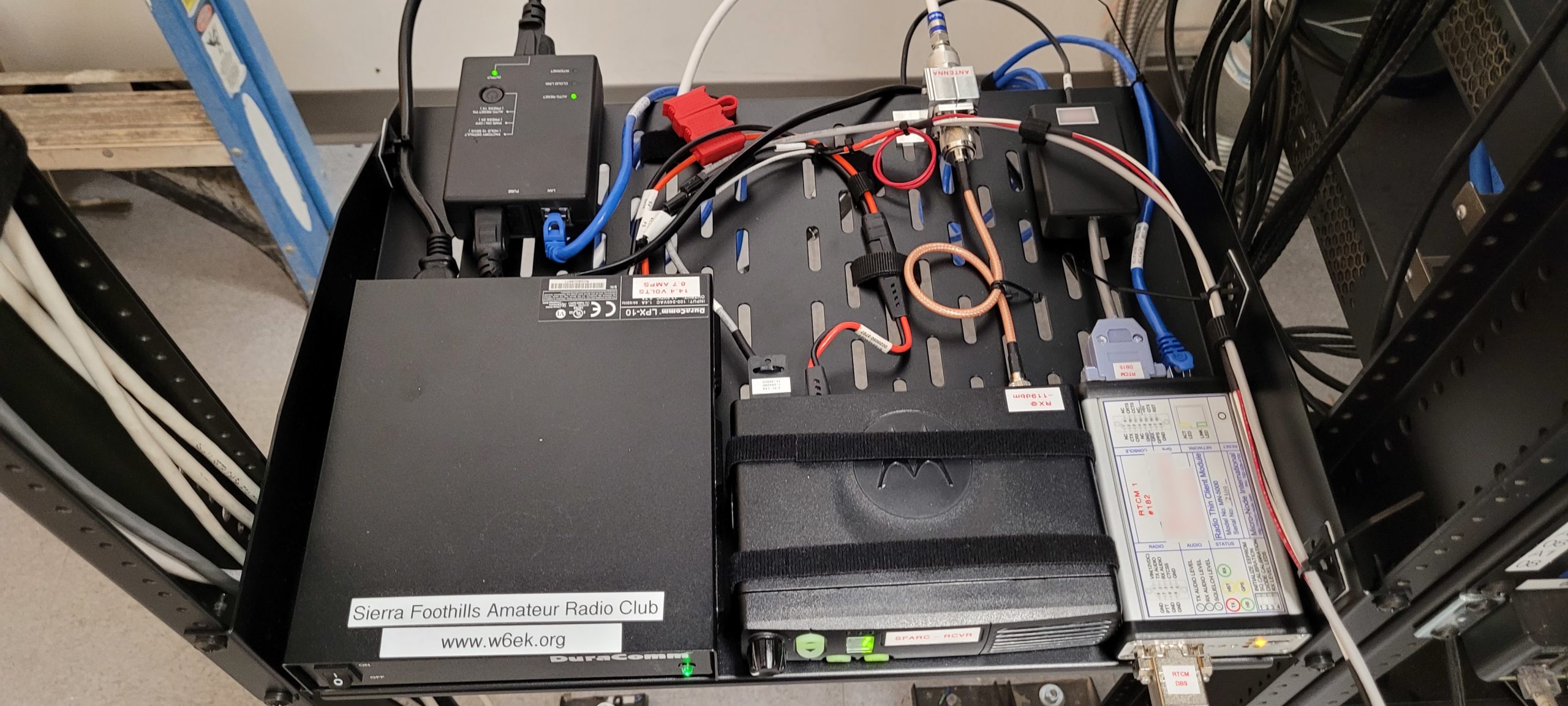
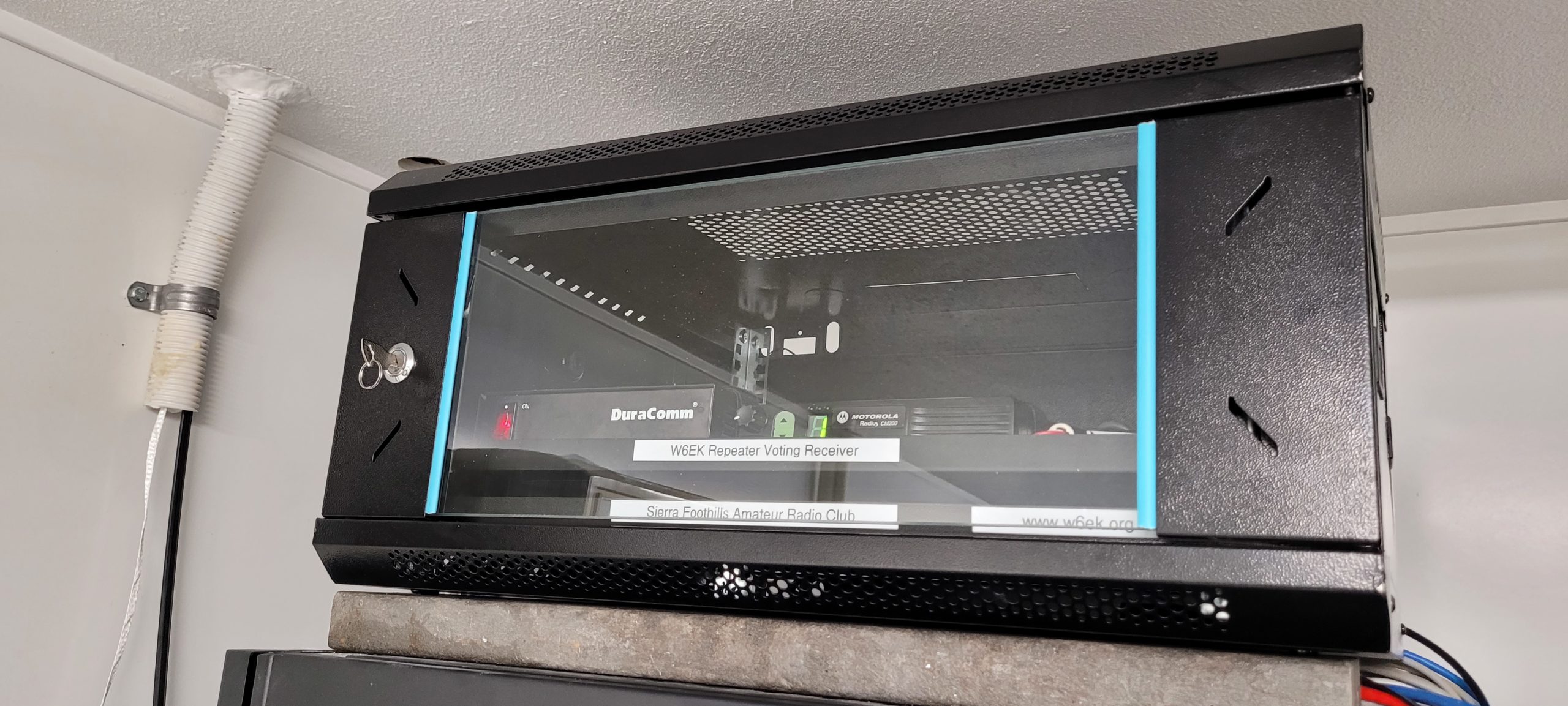
The transmitter is located near downtown Auburn at 1600’ elevation with three remote RTCM voter receivers. The main voter receiver is located East of Auburn on Mountaintop @ 2130’ elevation. The second voter receiver is in South Rocklin @ 520’ AMSL and the third at the Georgetown airport @ 2625’ AMSL. Internet access is available via Allstarlink node # 51018, Echolink node # 4128 and monitored on Broadcastify.
AllStarLink Inbound
Connect to the 2m repeater via AllStarLink from any ASL enabled repeater, node, computer or smartphone app. The W6EK 2 meter repeater’s ASL node number is 51018.
Echolink Inbound
Connect to the 2m repeater via Echolink from any Echolink enabled repeater, node, computer or smartphone app. The W6EK 2 meter repeater’s Echolink node number is 4128.
Broadcastify
Listen to repeater traffic through the Broadcastify.com website service or using a smart device with a scanner app. The repeater audio channel is: W6EK 145.4300 MHz Sierra Foothills ARC Repeater – https://m.broadcastify.com/listen/feed/32073
A net is a scheduled on-air meeting of amateur radio operators. Everyone tunes to the same frequency at the same time and takes turns checking in.
WHY CHECK IN?
Nets are the easiest way to get comfortable on the air. You practice clear operating habits, test your station against a known signal, meet local operators, and build the routine that makes emergency communication work when it matters.
SFARC NETS
All nets are held on the W6EK 2M repeater system, AllStarLink Node #51018, and Echolink #4128.
NAME
TIME
TYPE
COFFEE BREAK NET
365 Days A Week
0730-0900 PT
SFARC Net
Net Control(s): Brian (AI6US), Gerry (WA6E), Theta (WA6EWF), Tom (NN6H), Orion (AI6JB), Jeff (KW6U), Smitty (WB1G), Aaron (W1ATB), and Don (WB6LPJ)
CLUB WEEKLY NET
Weekly (Thursday)
1930-2030 PT
SFARC Net
Net Control(s): Dave (WB6RBE), Chip (KM6MDF), Smitty (WB1G), Orion (AI6JB)
ELMER NET
First and Third Wednesday each month.
1930-2030 PT
Sponsored Net
Owner / Net Control: Erik (W6EMR)
ALL-NODES NET
Weekly (Monday)
1800-1900 PT
Sponsored Net
Owner(s) / Net Control(s): Tom (NN6H) and Patrick (N2DYI)
PLACER COUNTY ARES NET
3rd Sunday of the Month
1930-2000 PT
Sponsored Net
Owner / Net Control: Scott (KM6RFB)
WEEKLY CLUB NET
Every Thursday starting at 7:30 PM Pacific Time (PT). Our nets are held on the club repeater. Everyone is invited to check-in. The net features a Mystery Question, the ARRL Report, Satellite Report, DX Report, and other activities. Operators are encouraged to talk about their recent operating or other ham activities. Want to be added to the roll call, send us your info:
THE COFFEE BREAK NET
Every morning from 7:30-9 AM PT. What a great way to get your day underway! You never know what we might be talking about. Almost any subject is on the table: technology, trivia, RVs, camping, fishing, brewing, astronomy, photography, kit builds, Instant pots, and much more! Grab a cup of coffee and stop by some morning. Everyone is welcome.
ELMER NET
Starts at 7:30 PM PT and is held every First and Third Wednesday, monthly. This net discusses various aspects of “how to” and provides assistance and advice to all Hams. Everyone is invited to check-in. Have a question, need an answer? then try the Elmer Net. We have many regulars that can answer your questions and provide operating assistance for Antennas, Equipment, Regulation, and any other aspect of our fine hobby. New or seasoned operators, there is something for everyone on the Elmer Net. Have a question or need some help? Please check-in.
ALL-NODES NET
Every Monday at 6:00 PM PT, this net is the place for discussions related to the setup, configuration, and operation of digital nodes and the associated hardware. A great place for noobies and experienced users alike.
** To help balance connection loads during high traffic nets, consider connecting to:
503680 – Fremont, CA 503681 – Dallas, TX 503682 – Boston, MA
Also available on:
DMR: TGIF Talkgroup 6633
DSTAR: XLX679C
PLACER COUNTY ARES READINESS NET
Click Here For More Information
The Placer County Amateur Radio Emergency Service (ARES) consists of licensed amateurs who have voluntarily registered their qualifications and equipment for communications duty in the public service when disaster strikes. The Placer County ARES net is on the 3rd Sunday of the month, starting at 1930 (7:30 PM) PT on the W6EK 2M Repeater. Everyone is invited to check-in. You do not need to be an SFARC member to participate.
440.575 MHz
Offset: +5.0 MHz
CTCSS (PL): 162.2 Hz
Digital: DG-ID: 00
YSF06040: US-NorCalRptGrp Full Time Connected Linked to Wires-X NorCal Repeater GRP** (#43847) ** All repeaters in this group, including W6EK the 70 CM machine, operate in auto mode select (AMS). All machines require operation in DN mode (C4FM) to be heard across the linked system.

 Somewhere above your head, right now, there’s a satellite you could talk through. There’s a balloon sending back weather data. There’s a stranger in Japan who’d be delighted to hear from you.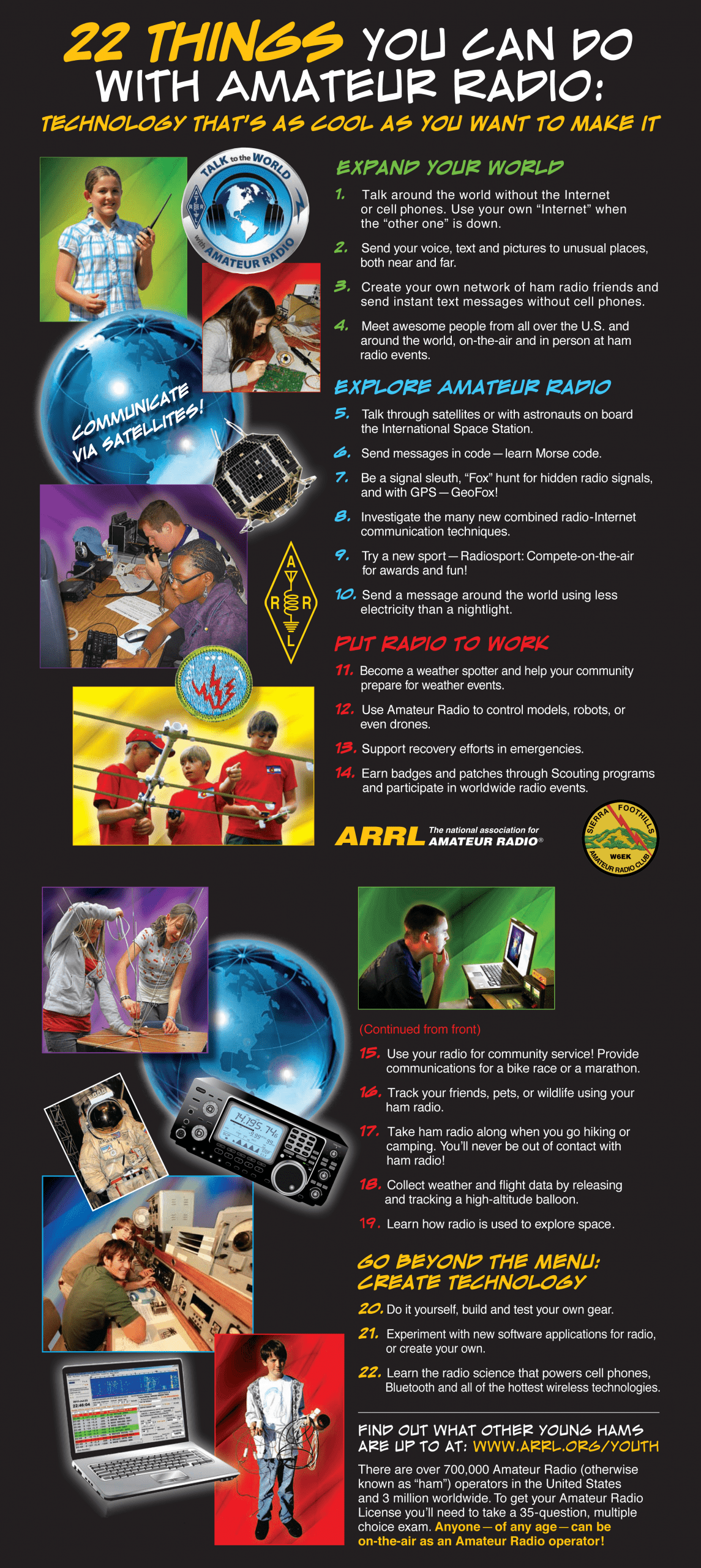
 Every Thursday starting at 7:30 PM Pacific Time (PT). Our nets are held on the club repeater. Everyone is invited to check-in. The net features a Mystery Question, the ARRL Report, Satellite Report, DX Report, and other activities. Operators are encouraged to talk about their recent operating or other ham activities. Want to be added to the roll call, send us your info:
 day underway! You never know what we might be talking about. Almost any subject is on the table: technology, trivia, RVs, camping, fishing, brewing, astronomy, photography, kit builds, Instant pots, and much more! Grab a cup of coffee and stop by some morning. Everyone is welcome.
 Every Monday at 6:00 PM PT, this net is the place for discussions related to the setup, configuration, and operation of digital nodes and the associated hardware. A great place for noobies and experienced users alike.