

THE STORY OF SFARC
Sixty-Eight Years on the Air
The club now known as W6EK began at 8:15 in the evening on July 16, 1958, when twenty people crowded into the U.S. Naval Reserve Electronics Facility in Auburn to ask whether the town needed a radio club. It has been organized, allowed to lapse, resurrected by a mailed questionnaire, and rebuilt more than once since — and it has signed the air under six different callsigns along the way.
Founded: July 16, 1958 · ARRL affiliated: January 23, 1965 · Members: 371 · Presidents: 33
Select a section to open it.
Version 4.6 · Last updated October 6, 2026, 10:50 a.m. PT
1958 — Twenty people and a borrowed building
Secretary Arlene Murch’s minutes of the first meeting record the exact time — 8:15 P.M., July 16, 1958 — and list everyone in the room. Among them were Theron “Woody” Woods W6ANX and his wife Katherine W6HDG; W.C. Bauman K6CBP, whose callsign the club would later adopt as its own; Walter Dowdy WN6PMF; R.H. Hicks K6VSS, who was still examining candidates for the club forty-four years later; Earl Wilson, K6GPB, who would still be a member of this club sixty-eight years later; Jim Carman, whose name would recur for the next fifty years; and three boys with no callsigns at all, one of them ten years old.
The minutes give five reasons for forming a club, and they read like a mission statement the club never really abandoned: to help each other with equipment, operating and TVI problems; to make Civil Defense and public service work more effective; to encourage and assist prospective amateurs toward their licenses; to plan Field Day and transmitter hunts properly; and “so that some sort of message handling plan can be worked out for the Auburn area.”
Officers were elected two weeks later, on July 30: Woods as president, Gerald Murch vice-president, Arlene Murch secretary, Bob Hicks treasurer. Dues were set at five dollars a year, or fifty cents a month. Someone asked whether the club would incorporate or affiliate with the ARRL. The minutes note simply: “This was left pending.” It stayed pending for seven years.
The name was a contest
Sixteen names were submitted, with Walt Dowdy donating a prize for whoever suggested the winner. Two finalists survived to a vote on August 13, 1958: Sierra Foothill Amateur Radio Club and Mother Lode Amateur Radio Club. The majority chose the former — recorded in the minutes, and worth noting, in the singular: SIERRA FOOTHILL A.R.C.
The plural crept in rather than being adopted. By the time the ARRL Repeater Directory listed the club in 1974 it was printed “Sierra Foothills ARC,” and the newsletter masthead used the plural throughout the 1990s — but the club’s own membership application form still read “SIERRA FOOTHILL” until it was redrawn in October 1994. No bylaws amendment, no vote, and no discussion of the change appears in any surviving record. The club simply drifted into its present name over about thirty-five years.
1958–1967 — A club without a room
The early club was itinerant and small. It met at the Naval Reserve building, then the fairgrounds “in the area next to the dance floor,” then — for years — in members’ living rooms. The 1961 minutes name the host each month: Craig Tindall’s in February, Lin Hunter’s in March, Walt Dowdy’s in April, Mike Bowman’s in May, Jim Carman’s in August, Sage Otow’s in September, Frank Carman’s in November. Attendance ran around fourteen, refreshments were served at the end, and in July 1961 the club simply took the month off.
Meeting after meeting turns on the same unresolved problem. In January 1961 Carman explained the possibility of getting a room in the old Naval Reserve building once a new one was built. By March the Fair manager had indicated “the rear room of the old Naval reserve building would quite sure be available,” and the president and secretary were appointed to put the request in writing. In April, Carman reported that construction had started at the new site and “BC 610 transmitter would probably be left for our club use.” By November the building was “not completely vacated yet, and we are waiting for time.” In January 1962 he reported it was being handed to the Fair Board and the club should move immediately, because Civil Defense and City Recreation wanted it too. The club never got the room — but it got the transmitter, and sold that BC-610 for $225 in 1963 when it needed the money. It settled for sharing the Civil Defense room at the fairgrounds from March 1962.
Teaching, raffling, and a county fair
For a club with no premises it did a great deal. A code and theory class ran at Craig Tindall’s home on Mondays and Thursdays with about six students, and in April 1961 the minutes record that “of the code class Dick Lund and Howard Davis received their conditional examinations” — which is how the club’s longest-serving officer got the license he would hold for the rest of his life.
In August 1961 the club “agreed to order a Heath Two-er and raffle it off to raise some money for the club treasury.” By November, Vice President Jim Carman was running ticket sales, $57.00 had come in, and plans were already being made for a second one. For scale: the treasury that October stood at $22.84.
And in September 1961 the club was asked to put a station in the commercial building at the fairgrounds, so it canceled the regular meeting and went:
Jim and Sage put up a 75 M. antenna. Jim brought his transmitter and used Sage’s SX100 receiver. Jim operated the station most of the time as K6ARR portable 6, and also completed the Heath two-er and put it on the air. There were approximately forty registered in the guest book on the last two days. We were awarded a participation certificate and ribbon from the fair.
Two-meter operation ran alongside Buzz LaBonte K6KDU, who was running the Civil Defense booth. It is the club’s first recorded public demonstration, and the ancestor of every Field Day, hamfest and Hot RF Night since.
The earliest death in the club’s records also falls here. In March 1961 the minutes note that “Lewey Blender, W6LRW passed away and a bill of $5.20 for flowers were approved to be paid to Footes Florist.” His name appears nowhere else in anything that survives.
The first station license, 1962
The club’s first attempt to affiliate with the ARRL failed. The minutes of April 14, 1962 record that President Dick Lund read a letter from the League about affiliation and Field Day, but “the club is unable to qualify with the required minimum 10 subscriptions needed.” The same meeting produced something more lasting: “Jim Carman volunteered to get the station license started before the $5.00 fee charge date. Because of this the club constitution needed some amendments” — and the officers met four days later to modify the bylaws accordingly.
That license was K6CBP, the callsign of founding member W.C. Bauman, and it became the club’s own. By January 1964 the treasurer was reporting “$76.43 in K6CBP checking account with BofA,” with Jim Carman named as trustee.
Traditions that started before the club was ten
Field Day participation was approved unanimously on June 1, 1960, with the site “tentatively the Bob Davis hilltop.” The first documented Field Day ran May 9, 1962 at Mt. Howell, two miles west of Colfax; the earliest surviving score is from June 1964, when Carman reported that 175 stations had been contacted for 1,188 points. A barbecue at the recreation park became annual from August 1959 — steaks, pop and ice cream free to members, guests fifty cents.
And the club was on the endurance trails from the very beginning. A 1962 account reprinted from RAMS News describes the July 14, 1962 Tevis Cup ride — thirty-three horses — worked on 3965 kHz AM with a two-meter AM relay, naming among the operators “WA6HYO-Dick, K6ARR-Jim, WA6HGH-Floyd, WA6THI-Carol — of Auburn.” By 1965 the club was running a full network of checkpoints: Tahoe, Robinson Flat, Michigan Bluff, Echo Hills, and “Base — K6CBP.” Sixty-four years later the club still gets priority use of its repeater for the same two events.
The high-water mark, and then the slide
The club’s best night in this era was November 11, 1964. The VFW, VFW-WWI and American Legion agreed to sponsor it and provide a meeting hall; meetings moved to the third Wednesday; dues were restructured to $1.25 a quarter or $5.00 a year; the Sierra College and Placer High School radio clubs affiliated with SFARC; and a motion by Lee Bowman, seconded by Jack Shrawder, “that SFARC affiliate with ARRL” finally carried. The ARRL recorded the affiliation on January 23, 1965. The same period produced the club emblem, adopted March 11, 1964 in green and gold, and a club QSL card and Award Certificate designed by Ken Weger.
But the decline had already begun, and the minutes are candid about it. June 14, 1963: “It was decided that no club field day be held because of lack of interest. Those present decided to adjourn the club until September 1963. Most members thought the group should be kept together, but as an informal social session each month instead of an official club.” That autumn: “The CD bldg on the Fair Grounds is no longer available to us for meetings.” Meetings were repeatedly canceled for want of a quorum.
The membership numbers tell it plainly. Thirteen paid members in August 1965, with $34.40 in the bank. Seven that December — too few to hold the annual election, so they ate cookies and adjourned. Eight in June 1966. Five that October: “Had an eyeball QSO and then went home.” And in April 1967, the whole of the minutes:
Building locked so Bob and I stood outside and talked. Carl and his XYL came later and we talked for a while and went home.
— Dick Lund WA6HYO, secretary, April 19, 1967
1967–1972 — The Lost Years
What makes the ending remarkable is that the club wrote it down as it happened. Dick Lund kept the minutes through the final two years, and they read less like a record than a diary.
March 16, 1966 still sounds like a functioning club: nine members and a guest, President Joe Merryman presiding, a code and theory class with fourteen students, a mobile run to Reno planned for April, RACES progress reported and the two-meter pole up, and a movie shown. By May it was eight members, with Joe wanting to clear out “the junk at his house that belongs to the club.”
Then it thins out.
- August 17, 1966 — “Les and Dick only ones who put in appearance. May be Les’ last chance to attend before starting at U.C. Berkeley.”
- September 21, 1966 — “There were five members present but no formal meeting was held. Carl Rolufs paid his dues for the year and we had a ‘bull session’ for a while. Then we adjourned to the Koffee Kup where Carl treated us to cakes and Coffee.”
- November 16, 1966 — “Seven members present. Had movie & eyeball QSO.”
- January 17, 1967 — “Met at home of Dick Lund. Four members – Carl – Jim – Sage & Dick + one visitor – Jerry Murch. No formal business. Cake and Coffee served.”
- February 15, 1967 — “Met at Memorial Hall… but no formal meeting. Good eyeball QSO held.”
- March 15, 1967 — “Met at Memorial Hall. Joe, Carl, Sage, Dick and Bob present. Wendell Robie passed through and when queried said the trail ride would be held July 28th. We adjourned to Koffee Kup where Joe bought the coffee.”
That March entry is worth pausing on. Wendell Robie founded the Western States Trail Ride — the Tevis Cup — and here he is wandering into a nearly empty club meeting to pass on that year’s date. The club had been working his ride since 1962 and would work it again within months, even as it was losing the ability to hold a meeting.
Then April, with the building locked. And then May 17, 1967, the last word before the end:
Bob, Sage, Carl, and I met at Memorial Hall, but we didn’t have the key to get in, so we had an eyeball QSO outside. Then we regrouped at the Koffee Kup where Dick bought the Coffee. Not much enthusiasm in this club. Field Day and Trail ride coming up. Will see what develops.
The last official meeting of the original club was held on June 21, 1967, with seven members present. They discussed the upcoming Field Day and next month’s hundred-mile horse ride, signed up again for RACES, and looked at Jim’s photographs from previous Field Days. Ken Weger suggested moving the meeting nights and the meeting place to his room at Sierra College. Dick Lund closed the minutes with a question that went unanswered for five years:
Anyone else have any bright ideas?
— Dick Lund WA6HYO, June 21, 1967, the club’s last meeting
Writing for the thirtieth anniversary of the revival, the club’s historian Gary Cunningham KQ6RT put it this way: “The last meeting of the original club was held in June of 1967. It is unclear what happened, and there are no clues revealed in the minutes of the meetings. Perhaps there was just a lack of interest? Maybe there are some of the original members out there who still remember. For whatever reason the club remained dormant, until two members stepped forward and took the initiative to put things back together.”
1972 — Brought back by a questionnaire
The revival has a date, a method, and two names. From the minutes of August 1, 1972:
Five years later Ken Weger took what was left of club and reorganized K6CBP into a two meter repeater station with Jim Carman as president and Ken Weger as secretary/treasurer. Weger has sent out a questionnaire to former members for above approval. Most agreed and it was so acclaimed, SFARC now active again!
So the club did not come back as a meeting. It came back as a machine — and it came back because Ken Weger WA6EMU mailed a survey to everyone who used to belong and asked whether they wanted it back.
Weger is the under-told figure in the club’s history. He joined SFARC in 1959, helped write its first constitution and bylaws in 1960, created the club logo and emblem in 1964, became Life Member #2 and the holder of SFARC Award #1 that same year, and started the club newsletter as its first editor. He had already helped Carman build a two-meter repeater once, in 1963. In 1972 he put the whole club back together, and then bought it a duplexer.
What they built, month by month
The minutes of the revival read like a receipts file, and they are the best record the club has of how it got back on the air.
| Date | What happened |
|---|---|
| August 1, 1972 | Weger reorganizes K6CBP into a two-meter repeater station; Carman president, Weger secretary-treasurer. “SFARC now active again!” |
| October 7, 1972 | Carman and Weger attend a CARC meeting; K6CBP becomes an associate member and is assigned the pair 146.16 in / 146.76 out |
| October 8, 1972 | K6CBP buys a Motorola two-meter station for $105.00 from Clyde Derby WB6IAW; Carman fixing it up for repeater service |
| October 22, 1972 | A shed for a repeater site, 4′ × 8′ × 7′, bought for $90.00 from the Royal Oaks Mobile Park. A heavy-duty tower obtained free from the Bureau of Land Management at Auburn Dam, dismantled and stored at K6ARR |
| December 10, 1972 | Two Ringo antennas, plus a tone decoder and encoder for control, $51.84 from Boyd Brandt WA6RYO |
| January 1, 1974 | K6CBP (SFARC) receives the repeater callsign WR6ADI, with President Jim Carman as Trustee. Put on the air with control operated manually from Carman’s home |
| October 12, 1974 | Ken Weger WA6EMU gives the club $300 worth of duplexer as a long-term loan, and installs antennas atop a tree at Carman’s place |
| November 10, 1974 | “Great News” — the repeater moves into the Placer County Sheriff’s communications vault, courtesy of Captain Ed Presly. John Barnhill WB6OHV donates the 450 MHz transmitter/receiver control link, which Carman modifies with a phone-dial control |
| December 22, 1974 | Remote control established on 445.575 in / 440.575 out, granted by CARC — the origin of the club’s 440 pair. Three members hold control: WA6EMU, K6ARR and a third whose call the minutes print as WB6OVH |
| January 1, 1975 | “Membership is now open to guest at a donation of $5.00 or more… for moral support of this open repeater station“ |
The club was formally re-constituted with a full officer slate in November and December 1977, when the local amateurs using WR6ADI met at the Auburn Fairgrounds to “reactivate the club into a more structured type as it used to be.” Carman served as president for six consecutive years, 1972 through 1977 — still the longest tenure in club history. Growth was immediate: 26 paid members in January 1978, 41 in February, 52 by April.
The local amateurs knew what they owed him. From the minutes of November 11, 1976: “Held a surprise dinner party in honor of Jim Carman (Trustee) at Pinnacle Peak steak house. Many of the local Hams showed up and many paid their contributions.” Two years after he put WR6ADI on the air, they threw him a party and settled their dues at the same time.
The six callsigns
The club and its repeaters have signed the air under six different callsigns in sixty-eight years. Four of them belonged to individual members before they belonged to the club.
K6CBP — c. 1962 to the 1970s
The club’s first station license, taken out by Jim Carman in 1962 under the callsign of founding member W.C. Bauman, who had been in the room at the first meeting in 1958. K6CBP held the club’s bank account in 1964, worked the Tevis Cup base station in 1965, was the entity that received a $50 donation from Explorer Post 29 in 1973, and was the licensee that applied for the club’s repeater callsign. By January 2004 the club’s editor noted in print that “the club call, K6CBP is currently unassigned in the ULS” — it had lapsed and been released, which is the proximate reason the club went looking for a new one in 2005.
Ken Weger’s own chronology dates the first club repeater to 1963 and prints its call as “W6CBP” — almost certainly a slip for K6CBP, since every other record gives the K-prefix form.
K6CBP was also more than a station license: it was part of the club’s identity on paper. A surviving SFARC Life Member card from the 1970s is printed across the top “LIFE MEMBER — WR6ADI/K6CBP”, with the holder’s own callsign written in by hand below. The club carried both calls side by side — the repeater’s and its own — and went on doing so after WR6ADI was granted in 1974.
A correction. An earlier version of this history said that K6CBP passed to Craig Bledsoe, the club’s 1979 president, and lapsed in Alaska. That was wrong, and the error was inherited. The club’s own newsletter of November 2010 reported a letter from “Col. Craig Bledsoe, KL4E, ex K6CBP,” and this page repeated it. Col. Bledsoe has since read that passage and corrected it himself: he was K4TXK for the entire time he lived in Auburn, took KL4E only after moving to Alaska when vanity callsigns became available, and in 2020 — tired of operators on HF assuming a “4” meant somewhere near Puerto Rico — changed to the traditional Alaskan call KL7H, which he holds today.
The likely source of the mistake is the card itself. Craig’s life member card reads “LIFE MEMBER — WR6ADI/K6CBP” across the head and “LICENSE… K4TXK” in the body. Someone in 2010, looking at a card that carried the club’s callsign in bold type and the member’s in handwriting, read it the wrong way round. It is a useful reminder of how a small error gets into a record and then survives for sixteen years because each person who repeats it is quoting a source they trust.
So where K6CBP went is unknown again. The editor found it unassigned in the ULS in January 2004; nothing in the club’s files says who held it between the 1970s and then, or whether anyone did.
WR6ADI — January 1, 1974 to c. 1983
From roughly 1972 until about 1983 the FCC issued amateur repeaters their own station licenses under a distinctive WR prefix. The club’s machine held one, and we now have both the date and the trustee: “K6CBP (SFARC) received the repeater call WR6ADI with President Jim Carman as Trustee,” January 1, 1974.
The callsign is independently confirmed in four consecutive editions of the ARRL Repeater Directory. The 1974–75 edition lists “Auburn … WR6ADI … 146.16 … 146.76 … Sierra Foothills ARC … K6ARR … 3/74,” naming Carman as the contact of record. The entry recurs in 1975–76, in 1976–77 with a NARC coordination stamp dated February 1976, and in 1977–78. It is absent from the Summer 1972 edition, which brackets the machine’s first appearance neatly against the revival.
WB6OHV — the 220 machine
The club’s 1.25-meter repeater on 223.860 signed under WB6OHV — the callsign of John L. Barnhill of Auburn. He first appears in the minutes of November 10, 1974 donating the 450 MHz control link that let the club control WR6ADI remotely, and he was still winning raffle prizes at club meetings in February 1983. His callsign is printed in the newsletter masthead on 223.860 from 1992 into 1997; the club’s repeater listings quietly drop it after that, and by 2001 the 220 machine is listed with no callsign at all.
Barnhill was a serious Northern California repeater builder beyond this club — he is remembered as one of three partners in the N6NMZ open-repeater network, whose surviving partners describe him as “our late friend John.” His FCC license ran to December 12, 2004 and was not renewed.
K6ARR — c. 1983 to 2009
Jim Carman’s own call. When the FCC ended the WR-prefix program the repeater reverted to its trustee’s personal callsign, and stayed there for roughly a quarter-century. The masthead of the club newsletter still read “K6ARR/R 145.430” as late as September 2009, changing to W6EK/R between the September and October issues; the entry in the national repeater database was not updated until November 8, 2010.
The relationship was explicit in print for decades: every masthead through 2001 read “K6ARR & Club Repeater,” naming the two side by side rather than merging them. The November 1993 ballot describes him as “K6ARR Jim Carmen owner of the repeater.” The club paid the power bill and voted the upgrades; Carman owned the machine, held the trusteeship, and held the site lease. An ARRL certificate presented to the club in 1998 is addressed “Sierra Foothills Amateur Radio Club, K6ARR” — for a while, his call effectively was the club’s.
W6RFF — borrowed every Field Day, c. 1988 to 2004
Having no usable club callsign of its own, SFARC spent about seventeen years borrowing one. W6RFF was the personal call of Jettie Hill, licensed in March 1939, an SFARC life member and for eleven years the ARRL’s Sacramento Valley Section Manager. A 2002 profile puts it plainly: “Somewhere around 1988, probably when he served us as President, we began using his call for the SFARC Field Day operations. We’ve been using it ever since.“
And so they did — 1993, 1994, 1998, 2001, 2002, 2004, each year with a thank-you in the newsletter. “I have spoken to Jetty Hill about the club using his call sign for the Field Day event and he has given his permission, so once again we will be proud to use W6RFF.”
W6EK — September 2005 to present
“Casey advised that the new club call sign was official: W6EK,” per the minutes of September 9, 2005. The FCC record gives the license an original issue date of September 10, 2005, held by Sierra Foothills ARC of Auburn as a club vanity license, and it has been renewed twice since. The club adopted it at once; the repeater kept signing K6ARR/R for four more years.
Who held W6EK before 2005 is still unknown. The one search hit for the call is a 1930s QST mention that cannot possibly be connected to this club — a 1×2 callsign would have been reassigned many times over.
1978 — Fifteen dollars in crystals
The club’s two-meter output frequency has a precise birthday. Through 1977 the repeater ran 146.16 in, 146.76 out — the pair CARC had assigned it in October 1972. In February 1978 the club voted to move to a 146.145/146.745 pair, noting the Placer County Sheriff’s Communications Reserve would take 146.175/146.775, and estimating the cost of the change at fifteen dollars in crystals. That plan was superseded within two months.
On April 14, 1978, Carman reported to the Technical Committee that WR6ADI would change frequencies on May 15, to 144.83 in / 145.43 out. On May 11 he confirmed it would happen that weekend. The reason was given in the club’s own trivia column years later: “It was originally on 146.760, possibly the second most popular repeater frequency after 146.940. Jim moved it when the new 145 Mhz sub-band was opened to repeaters to escape serious interference from a Bay Area repeater.“
That output frequency has been in continuous use ever since — going on forty-eight years. The 220 machine’s 223.86 output is nearly as old, appearing in the minutes of December 1977, and the 440 pair traces back further still, to the control link CARC granted in December 1974. The two-meter antenna was still cut for the old 146.76 in 1993, when a board inspection found “a resonance with the antenna… because the antenna was originally designed for 146.76, which was as the old repeater frequency.”
| Changed | Input / output | Notes |
|---|---|---|
| October 1972 | 146.16 / 146.76 | Assigned to K6CBP by CARC at the revival; carried into the WR6ADI license |
| February 1978 | 146.745 / 146.145 | Voted and costed at $15 in crystals; superseded before it took effect |
| May 15, 1978 | 144.83 / 145.43 | Moved into the newly opened 145 MHz repeater segment to escape a Bay Area machine. Still in use |
1979, from someone who was there
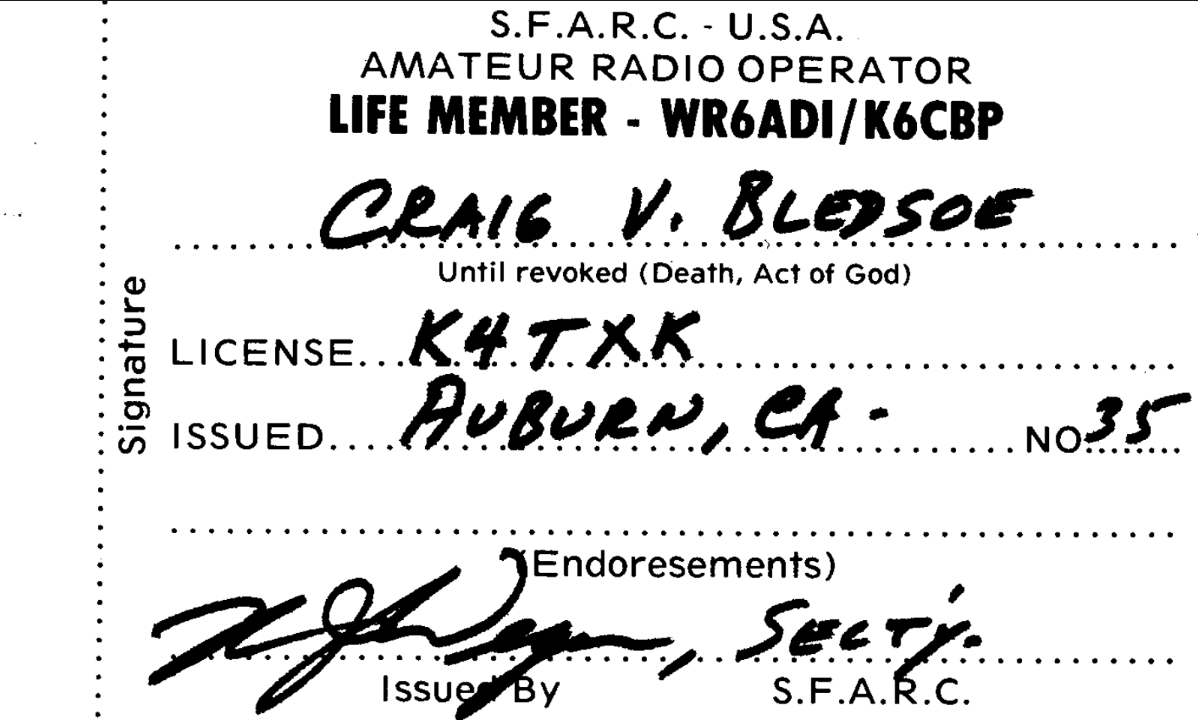
Almost everything above comes from minutes. For the late 1970s the club has one first-hand voice, and it belongs to Col. Craig Bledsoe, then K4TXK and today KL7H, who was president in 1979 and who read this history in 2026 and wrote back from Alaska.
His year, he says, “was during one of SFARC’s active periods, so we had lots of members participating in a multitude of outside activities, including Field Day, the Tevis Cup, and the Western States 100, that were all on the organization’s annual event agenda.”
That single sentence is worth a good deal. It confirms the club was healthy at the end of the 1970s rather than drifting toward the trouble that came in the mid-1980s; it puts the Tevis Cup — which the club had been working since 1962 — on a formal annual calendar by 1979; and it is the earliest evidence the club has that the Western States 100 was already an established SFARC commitment, a role the club still fills on those same trails today.
Col. Bledsoe also holds a Life Member card numbered 35, signed by the club secretary, issued at Auburn, and valid — in the splendid phrasing of whoever had the cards printed — “Until revoked (Death, Act of God).”
1983–1996 — The firehouse years
By 1983 the club had the shape it would keep for a decade. Mary Ann Simmons was president; the meeting night changed to the second Friday by majority vote that year, which is where it has stayed ever since; a separate repeater fund existed alongside the club account; and on a single night in October 1983 six new members joined, among them Bob Metke W6SUP and his wife Geri K6GKR, who would run the club’s volunteer examiner program for the next nineteen years.
The club met at the Placer County Board of Education building, 316 Nevada Street, and then at the Auburn Fire Station, 226 Sacramento Street — second Friday, 7:30 p.m. Mail went to P.O. Box 3262, Auburn, an address that briefly became “Bowman, CA 95604” in 1993 when the post office renamed it, then reverted. Dues were $12 a year in 1988 and still $12 in 1992, rising to $17 in January 1995.
A third near-death, around 1986
Somewhere in the middle of this decade the club got into difficulty again, and the evidence is frustratingly indirect. Writing to the membership in 2006, Jettie Hill W6RFF said: “I first joined SFARC in 1986 and served two terms as President.” He was president in 1987 and 1988 — which means the club handed its presidency to a man who had been a member for barely a year.
Ten years later, at the meeting where the club debated dissolving itself, Jan Huttula reminded the room that “W6RFF Jettie Hill had been elected as President under similar circumstances and had turned the club around.”
Put those two statements together and they describe a third near-death, serious enough that a nearly new member was handed the club and credited with saving it. No minutes, no newsletter and no roster from those years survives to tell us what actually happened. It is the largest hole in this history.
What the club actually did
The 1990s newsletters are relentlessly present-tense, and they show a club whose center of gravity was service and teaching rather than contesting. The volunteer examiner team, run by Bob Metke out of his private address in Roseville, California, had tested over 500 people by mid-1993 and handled 158 applicants and 278 exams in 1994 alone. Accessibility was a point of pride: home visits for the housebound, and a February 1997 session in which a blind candidate passed the 20-word-per-minute code test from brailled text and then the General, Advanced and Extra written exams in a single morning, finishing by 11:30. Mildred O’Brien W6HTS taught Morse code free of charge on Tuesday evenings for years.
The club ran transmitter hunts with a live “Rabbit” and cash prizes, an annual picnic at Meadow Vista Park with a best-mobile-installation contest and a legendary meat-bee problem, a White Elephant auction every October whose proceeds paid for the Christmas party, swap meets at a member’s Sacramento shop, and a long roster of community events — the Rocklin Jubilee parade, a Halloween safety patrol for the Rocklin police, the Roseville Holiday Parade, the MS Walk, the 49er Canyon Classic Biathlon.
Its defining emergency was the January 1997 floods, when nineteen members served in shelters, Red Cross centers and OES operations, Jan Huttula KC6LIX ran central dispatch on seven and a half hours’ sleep across two days, and Jim Carman gave the repeater over to the effort for seventy-two hours straight.
Field Day
Blue Canyon Airport was the Field Day site in 1978, 1983 and 1992. By 1993 the club had moved to Nyack, on Grant Wells’s property off Nyack Road at Emigrant Gap, around 5,200 feet — where it would stay for a quarter of a century. In 1990 the club made roughly 1,400 contacts. In 1994 it made 403 QSOs under W6RFF, 311 on SSB and 92 on CW, with the North Highlands National Guard unit supplying four generators and refueling them every five hours. In 1997 it made 266 contacts for 1,900 points across five stations, and in 1999, 442 contacts in 43 states and four Canadian provinces. The 1998 write-up caught what the weekend had become: “Field Day at Nyack has come to be more than just an exercise or a contest. It is also a chance for our members and friends to get together for a weekend camping trip and to get to know one another better in the beautiful high Sierras.“
The club’s own paperwork
Every 1993 financial report carries a budget line for a $5 “Corporation Fee”, and the November 1993 accounts show it actually paid, booked as “Incorporation $5.00.” The outgoing officers’ handover list for 1994 includes “Incorporation authorization” among the items to pass on, and the club’s auditors that year described the books as being brought “in accordance with the requirements for a not-for-profit organization.” So SFARC was maintaining a California corporate filing in 1993 — but no surviving newsletter names the Secretary of State, gives a corporation number or an EIN, or says when the corporation was formed.
The club also described itself as an ARRL Special Service Club throughout this period, in the masthead from 1993 and in the front-page banner from September 1994: “A SPECIAL SERVICE CLUB ASSOCIATED WITH THE AMERICAN RADIO RELAY LEAGUE.” That claim disappears from the newsletters in the 2000s, and the club applied for Special Service Club status again in March 2011, with approval confirmed that June. The designation appears to have lapsed somewhere in between and been regained rather than granted for the first time.
November 1996 — Elect officers or disband
Thirty years after the Lost Years, the club came within one meeting of ending for good. None of this was visible until the 1996 newsletters were digitized, because not one issue from that year had ever been published online.
The warning signs are in the publication record itself. From September 1995 the newsletter stopped appearing monthly and began coming out as combined issues — September/October, November/December, then January/February, March/April and May/June. The whole of 1996 produced three issues. After May/June there was nothing until January 1997.
The November 1996 meeting was called to settle the question. From the minutes:
WA6ULL Bob announced that the main purpose of meeting was to elect new officers or to disband the Club. WA6ULL explained the Club was very low on funds — only a few dollars, would not have enough money to run the Club through the next year, and did not have nominees to run for all offices.
He then read out the numbers. The club had taken in $1,776 that year and spent $1,775. “Thus, the Club had about $1.14 at this time.” Insurance had risen from $260 to $327. The newsletter cost $350, repeater electricity $270, the ARRL $146. The Christmas party fund was down to $130. Field Day had spent nothing at all. And the Auburn Fire Station, where the club had met for years, was now charging $40 a month that it could not cover.
The leadership had thinned to almost nothing. President Bob Boeckman WA6ULL ran the meeting essentially alone: the vice-president was in San Diego, the treasurer had moved to Concord, and the appointed secretary had simply disappeared — he “had not heard from her nor knew how to contact her.” Nineteen members were in the room.
What saved it
Jan Huttula KC6LIX, a past president, spoke from the floor:
Member KC6LIX Jan, past president of SFARC, reminded WA6ULL that the club has been in similar situations throughout its history. Fund raising could be done by the new Officers. W6RFF Jettie Hill had been elected as President under similar circumstances and had turned the club around.
That settled it. The club held the election instead. Greg Huttula KC6LOE was elected president, Dave Peden KA6KUT vice-president, Jan Huttula treasurer, with Bob Greenslade W3PMP, Dave Hund N6SHD and Chuck Eder W6LOE. Dick Wilkins WB6EDR closed the evening by talking about how to rebuild a radio club.
The recovery began at once. At the January 1997 board meeting Dave Peden put $100 of his own money into the treasury — the minutes say it plainly: “This money was donated to ensure SFARC returned to a monthly newsletter.” The new president set out to restore the monthly newsletter, to “again publish a fiscal report and minutes of meetings,” and to “use the bylaws to administer the action of the club.” That all three had to be announced as intentions says what the preceding year had been like. Henry Sparks KB2DLE, the vice-president who had been absent in November, “felt hopeful about the club’s future.”
One line in Jan Huttula’s intervention remains unexplained. Jettie Hill was president in 1987 and 1988, and her remark means there was an earlier rescue, under similar circumstances, that no surviving record describes. The club has nearly died at least three times, and we only have the story of two.
1997–2004 — The library, the website, and a name for the newsletter
Three things changed the club’s public face in these years, and all three are precisely dated.
January 1997 — out of the firehouse
The firehouse had become unaffordable. The November 1996 minutes record that “the Club did not have adequate funding to cover the $40 a month cost to meet in the Fire House.” This was not housekeeping. It was a cost cut made by a club that had, weeks earlier, voted on whether to dissolve itself. The incoming president convened a relocation team, over twenty sites were inspected, and the club moved to the Beecher Room at the Auburn-Placer County Library, 350 Nevada Street. The first library meeting was January 10, 1997, and five people turned up at the old firehouse and never found it. The club would meet at the library for sixteen years. Its mailing address moved to P.O. Box 1005, Newcastle, in January 1998.
January 2003 — sf-arc.org
The club had been on the web since 1998, but January 2003 brought its first site with a domain of its own, built by Justin Carpenter KG6NYD, the son of club vice-president Rob Carpenter. The hyphen was not decoration: the newsletter warned twice that “the ‘-‘ is critical. If you enter the URL without the hyphen, you’ll find yourself browsing the San Francisco Amateur Radio Club web pages.” That is the whole origin of the SF-ARC form of the acronym, which outlived the domain and confused the club’s own officers until 2012. The full story of the website is in its own section below.
January 2004 — Sierra Signals
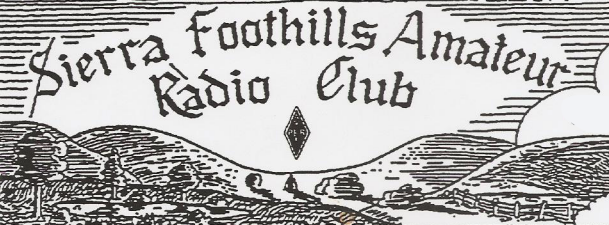
The newsletter had been “The SFARC NEWS” since March 11, 1964, when the membership formally adopted the bulletin Ken Weger had started as its first editor. In April 2003 the board voted to run a contest to name it properly, the prize a year’s free membership. The winning entry came from George Simmons KG6LSB, and the January 2004 issue led with “Sierra Signals Debuts — Welcome to the first issue of ‘Sierra Signals,’ formerly known as the SFARC Newsletter.”
The old masthead went out with it — drawn in pen and ink by Russ Ahlberg, who had become a silent key only months before, and which “survived scanning and pixel editing” for years. The new one was drawn by Kerry Kuepper, the treasurer’s wife.
The club’s historian
In January 2001 Gary Cunningham KQ6RT began a standing column reprinting the club’s minute books verbatim, starting with the meeting of January 11, 1961. It ran every month for years — “40 Years Ago,” then “30 & 40 Years Ago,” then “Jurassic SFARC” — and it is the reason this history can be written at all. Almost every quotation above from the 1958 founding, the 1960s decline and the 1972 revival survives only because Cunningham transcribed it out of the original books and into print. His own asides are part of the record: the 1963 minutes were “a bit sparse”; “1974 is a little thin. The club was reviving then”; and, pointedly, “My book ends in December of 1983.“
2005–2019 — A club that kept needing a bigger hall
The modern club’s story can be read almost entirely through the rooms it filled and left. It met in the Beecher Room at the Auburn Library until February 2013, when it voted unanimously to move because, as the minutes put it, “we have outgrown the Auburn library.” The first meeting at the Rose Room in Auburn City Hall drew about sixty people and filled the city parking lot.
Along the way it acquired most of what it now does. The club joined four neighboring clubs to launch the Sacramento Valley Hamfest in September 2008. It sorted out its long-neglected corporate paperwork in 2010, discovering it already had both a state corporation number and a federal EIN. Bob Brodovsky K6UDA proposed a club swap meet in July 2014, and the first Loomis Hamfest was held at the historic Loomis train depot in March 2015 for a $35 rental fee; by 2019 it was turning a $1,747 profit against a $702 goal and had been sanctioned as an official ARRL event.
One other episode from these years is worth recording. The club’s 70 cm machine spent much of 2012 off the air entirely: the 440 band around Beale Air Force Base was restricted for the PAVE PAWS early-warning radar under a Department of Defense mandate, and when the repeater came down its cables were cut, so returning it to service meant rebuilding the connectors.
Field Day left Nyack in 2019 after a quarter-century, moving to Blue Canyon Airport — a return to the site the club had used in 1978 — to escape the RFI from truck inverters and power-line signals. Winter Field Day began in January 2019 at Georgetown Airport and was added to the club calendar as an annual event that May.
The scholarship
In March 2018 the club lost Dan Fogard W6PRL — licensed in 1949 as W7VC, a CW operator who said that “to him, that is amateur radio.” His son Ken donated Dan’s equipment and asked that the proceeds fund a scholarship in his name for young people wanting a license. The board adopted a formal scholarship policy on November 9, 2018, and the fund paid its first award on June 14, 2019 to William “Willie” Lerma KN6BXV, with Dan’s family present. His certificate — the W6PRL Student Award — is still in the club’s files.
It has since grown well beyond exam fees. The current program gives first consideration to relatives of members, is open to high school seniors continuing their education, and states a preference for those enrolled in STEM fields; candidates are interviewed before the committee recommends them to the board, and each recipient gives a short presentation to the club on their goals. In 2026 it awarded six $1,000 scholarships across Sacramento, Placer and Yolo counties.
2020 — The year the club grew by going quiet
Placer County issued its first COVID-19 advisory on March 10, 2020. Three days later the board met by videoconference for the first time in club history — “an historical event of sorts,” the minutes noted. The Hamfest was postponed and then canceled; so were the Tevis Cup, the Western States Endurance Run, JOTA, the White Elephant auction, the picnic and Field Day at Blue Canyon.
The club’s answer was the repeater. In April, Brian Gohl AI6US started the Coffee Break Net on 145.430 — every morning, 7:30 to 10:00. It has run 365 days a year ever since and had logged some 16,000 check-ins by the end of 2021. Field Day became a 28-hour net with over 165 check-ins and a 24-hour Zoom room. Gerry Brentnall WA6E — a club director as far back as 1992, and the man who drew up the repeater site lease in 1994 — found the legal basis for online meetings in California Corporations Code §5211. The first online general meeting, on GoToMeeting, drew over 65 people on April 10. The club’s first Zoom meeting came on October 9, and the November election was its first electronic vote.
The same year, both main repeaters were rebuilt — two Yaesu DR2X machines, an amplifier bringing 2 meters to 80 watts, AllStarLink node 51018 replacing IRLP, and the 70 cm machine converted to Fusion C4FM on a donation from Scott KK7AIR.
Membership went from about 100 at the start of 2020 to 163 by December 31. The pandemic did not shrink SFARC. It moved it onto the repeater and grew it.
2021–2026 — Three hundred and seventy-one
The year opened with a loss. Jim Griffith KI6AZH — a long-standing club and ARES member known on the air as “The Voice on the Hill,” whose mountaintop above Christian Valley had hosted the club’s backup repeater — died on January 7, 2021, and the club held a moment of silence for him at its meeting the following evening.
The club met outdoors at the Methodist church in Loomis on August 13, 2021 for its first in-person meeting in nearly eighteen months — an event that doubled as the first Hot RF Nights car radio show. It then moved into the gym at Crossroads Church on Auburn Ravine Road, later renamed Confluence, where it stayed five years and ran hybrid in-person and Zoom meetings. In February 2026 it moved again, to the Cordova Room at the Placer County Health and Human Services conference center, and thanked the church with a $300 donation to the food bank.
Membership has more than tripled since 2019 — 371 as of this writing, drawn from across Placer County and well beyond it. The club has grown large enough that in-person quorum is now hard to reach, and most club business is decided by electronic ballot.
The repeater remains, in the words of a 2023 president’s column, “the heart of the club”: a Yaesu DR2X near downtown Auburn at 1,600 feet with three remote voter receivers, on the same 145.430 output Jim Carman moved it to in May 1978. Western States and the Tevis Cup still get priority use of it, as they have since 1962. In June 2026 the club put a 25-watt node with Starlink on Duncan Peak to extend coverage for Western States, and the Ironman Foundation gave $1,000 toward the repeater that made it possible.
The club that asked in 1958 whether Auburn needed a radio club, and got no answer at all in 1967, now runs a net every morning of the year.
The website, 1998–2026
The club has had a website for twenty-eight years, at five addresses, under eleven webmasters — and for three and a quarter years in the middle, under nobody at all.
May 1998 — the first site, on AOL
The club went online at the end of May 1998. The May issue carried a boxed notice: “Under Construction is SFARC’s Web Page… Courtesy of Greg, KC6LOE and Jan, KC6LIX It should be on the World Wide Web by the end of May 1998.” Vice-president Bill Parrish KM6KV had been helping Greg Huttula develop it. It lived free in AOL members’ space at http://members.aol.com/SFARC/SFARC.html, and the masthead carried a warning alongside it: “You need to use the capital letters SFARC in the address to visit the site.”
It held links to the club’s sister club in Long Beach, the Reno Radio Club, the ARRL, the QRZ callbook, the FCC, W5YI and the DMV, and a membership application you had to print out, because “the submit key has been removed from the application form because it was not working.” The club got its first email address at the same time, also on AOL.
The board voted $32.95 to Greg Huttula on May 22, 1998 toward the cost of building it. That was the only money the club spent on its website for the next thirteen years.
1999–2002 — donated space
By March 1999 the site had been rebuilt and rehosted: “All members please thank Web Page expert Chris Wright, KF6OGD, and his Father, for building the web page.” It moved to http://www.foothill.net/ham/sfarc, the space given free by Foothill.net of Foresthill — “WEB PAGE SPACE DONATED BY FOOTHILLNET… Thank You Foothill!” That address lasted only months. Sometime between March and July 1999 the site moved again, into Chris Wright’s own dial-up account at NewWorld — he signed himself wingman at that ISP, and the site took the handle with it: http://personal.neworld.net/~wingman/sfarc/, restyled partway through as http://users.neworld.net/wingman/sfarc. It stayed there for three years. Separately, Fred Jensen K6DGW ran a mirror of the newsletter out of his own ISP space at foothill.net/~andreaj, moved there in April 2002 “as a result of increasing difficulty with the previous ISP.”
It aged. In March 2001 President Matt Diridoni appealed in print: “I am looking for a person interested in building a new web page for the club. The one we have is really outdated, and needs some TLC.” Nobody answered, and nothing changed for two more years.
January 2003 — sf-arc.org, and a near-death
“SFARC Has A New Web Site! www.sf-arc.org… thanks to the efforts of Justin, KG6NYD, it has some really neat features.” Justin Carpenter was the son of club vice-president Rob Carpenter, and he built a real content-managed site — PHP-Nuke, running under sf-arc.org/html/ in the DeepBlue theme, the first time the club’s web presence had been database-driven rather than hand-written pages. It had a news front page, a clickable calendar with maps, member-registered classifieds, a downloads area for newsletters and presentations, an FAQ, a gallery, and forums — including an Elmer’s Forum moderated by Casey McPartland, where new hams could post questions and get help.
Then it fell over. By May 2004 the editor was asking in print: “The club’s web site… hasn’t responded in some time. Can anyone advise its status?” The rescue came from a stranger. At the meeting of September 10, 2004, “Marc W. North, W6SQL, joined the club during the meeting. Mark offered to take over the web site which was begun by Justin, KG6NYD, and to host it on his infrastructure.” The club accepted unanimously and waived his membership fee in thanks. The site was back by November 12, 2004.
Marc rebuilt it on his own platform of choice. By 2005 sf-arc.org was running Movable Type — posts filed under /archives/newsletter/, /archives/announcement/, /archives/outside_links/ and /archives/wanted_for_sale/, with RSS and Atom feeds — alongside a separate photo gallery at sf-arc.org/gallery/ holding albums for Field Day 2005, Dayton Hamvention 2005 and Casey McPartland’s shack. The newsletters of 2005 and 2006 were posted as two PDFs each, a front page and a body, downloaded separately.
2007–2010 — the years with no webmaster
Rick Prime K6TF took the job in April 2007, volunteering “to update the SFARC website with accurate information,” and started a club blog — a free WordPress.com site at www.sfarck6arr.wordpress.com, named for the repeater callsign of the day, intended as “a central place to go to and ask questions, commiserate with fellow club members or even post equipment to sell.” He appears in four mastheads. From September 2007 the webmaster line simply vanishes — and stays gone until December 2010.
For three and a quarter years the site was still up and still advertised, with no named keeper. Carl Schultz WF6J picked it up over the winter of 2010–11, and the January 2011 issue carried a box reading “VISIT OUR NEW WEB PAGE.” He held the job for four years, adding a past-presidents list, coax attenuation charts, a password-protected member roster, club webmail, and live propagation data on the home page. In December 2012 the club gave him a certificate for “Sustained Performance” as webmaster and public information officer.
December 2011 — w6ek.org
The club bought its own domain in December 2011. The expense appears in the treasurer’s report for that month — “reimbursement to the Webmaster for purchase of the W6EK.org URL” — and the president announced it in the February 2012 issue: “We now own the w6ek.org domain. The website is getting a complete facelift.” From the March 2012 issue the masthead read w6ek.org, the club had an email address on its own domain for the first time, and the old sf-arc.org was set to forward to the new site.
It also retired an awkwardness the club had carried for nine years. The January 2012 board minutes record the whole business plainly: “There had been some confusion as to whether the acronym for our Club was SFARC or SF-ARC. Richard reported that officially we are known as SFARC, but for Internet purposes we use SF-ARC to distinguish us from the San Francisco Amateur Radio Club organization. This may now be a moot point with the new Internet URL of ‘W6EK.org’.” The hyphen was never the club’s name. It was a workaround for a domain collision with another club three hours down the hill, and the callsign solved it.
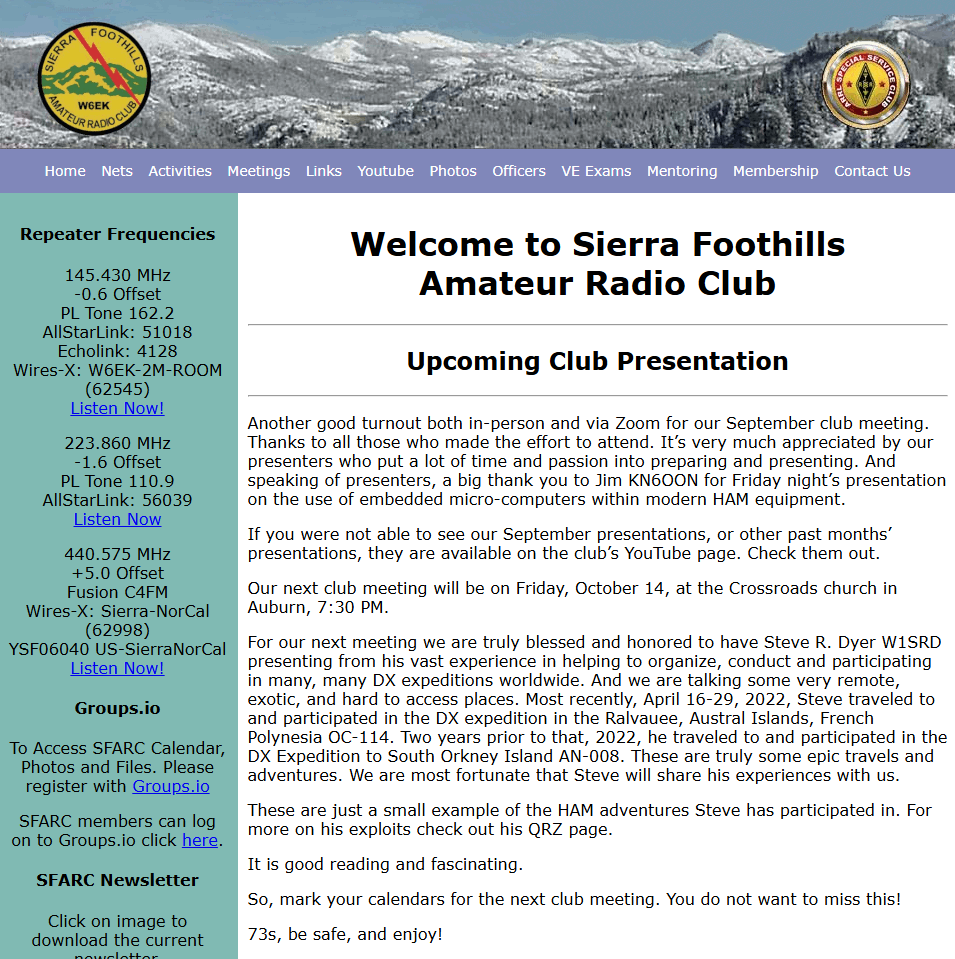
A “complete facelift” followed through 2012 — the navigation moved from a left-hand column to across the top, the layout went wide, officers’ photographs went in, the unused guest book came out, and the club logo was redrawn to include the callsign. PayPal dues payment arrived in January 2012, and a Yahoo! Group launched the same month. The pages themselves were hand-built in Adobe Dreamweaver, navigation sliced into rollover images and tabbed panels driven by Adobe’s Spry framework — a design that would carry the club, little changed, for the next decade.
2015–2022 — four webmasters and a hack
Carl handed over to director Birton Gilbert N6UG in April 2015, who shared the role with Dennis Gregory WU6X through 2016. Carl returned briefly in April 2017, then asked for a volunteer at the May meeting and Herb Garcia KM6JBI stepped up. Herb held it for five and a half years, and his big achievement was finally delivering what the club had wanted since 2012: “you may now simply complete the online membership application and pay via PayPal,” announced in February 2020.
In June 2017 the board floated moving the site to WordPress. Herb declined — “he is happy with the current software” — and the site stayed hand-coded HTML and PHP for another five years. Somebody tried it anyway. A WordPress installation went up at w6ek.org/blog on October 28, 2017, and the Internet Archive caught it holding nothing but the default “Hello world!” post. It was still sitting there, untouched, in March 2022.
In October 2019 it was broken into. The board minutes are the entire record: “Webmaster: Herb/KM6JBI announced that our site was hacked! There were two scripts on the site, which he removed. There are no credit card numbers or other or personal information on the site.” Four sentences, no vote, no expense, and no mention at all to the general membership. Hosting had been on GoDaddy since about 2011; in October 2021 the board voted to move to Ionos.
2022 — the rebuild, one brick at a time
In the late summer of 2022 the idea of moving the club off hand-coded pages and onto a content-managed platform was re-floated, and WordPress was considered seriously this time. Ideas were thrown around. Smitty WB1G put together wireframes and a working mockup of what the site could be, and took them to the board. After some deliberation the board approved the upgrade.
The new site was unveiled at the general meeting of November 11, 2022 — “New website presented by Smitty, WB1G” — but the launch was a beginning rather than a finish. Over roughly the next six months the W6EK.org people use today was built out one brick at a time, feature by feature: help videos in February 2023, the storefront by April, the file library and video archive through the spring.
What drove the whole project was not fashion but accessibility. The idea had first been raised in June 2021 — “They want to make the site accessible for the sight-impaired which is a super idea!” — and by September 2022 the president was explicit: “There are state required compliance issues which prompted a review… we make our website as accessible as possible.” An IT Summit convened over the summer of 2022, facilitated by Orion Endres AI6JB, reviewing the website, Groups.io, the treasury, the newsletter, VE exams and the repeater as one connected problem. Amir Larian N6ADL had joined the web team the year before. The vice-president’s column that month: “An excellent job by all those involved in the IT Summit and on behalf of SFARC, thank you for the long hours, hard work and great outcome.”
What the site gained in the four years since is most of what members now use daily: the storefront and the donation products, the merchandise shop launched in June 2025, the photo gallery and video library, the file library, the event and contest calendars, the Field Day Resource Center, member RSVP forms, the Watts Up weekly email, the Articles section, the Weekly Net Portal and net statistics, Broadcastify streaming links, this history page, and more than thirty vanity subdomains. HamClubOnline came in with the new site in November 2022 and now drives membership, dues and the club’s binding electronic votes. In March 2026 the webserver was wired into Groups.io as “SFARC Membership Support,” a ticket tracker handling about a dozen requests a week, and the monthly membership chores were largely automated away.
The one traffic figure the club ever published: in June 2023 the site took almost 4,000 hits, and the most popular page was the Field Day Resource Center.
What people actually come for
The site’s own analytics, covering 2020 to October 2026, settle the question of what people actually come to w6ek.org for. After the home page, the most-visited page on the entire website is /repeaters/detail_2m — 13,486 views, ahead of Hamfest, ahead of the calendar, ahead of the newsletter. Add the other repeater pages and the coverage maps and the cluster passes 23,000 views. Field Day led for one month in 2023; the repeater leads across the whole run.
What the numbers also show is a site people use rather than just read. The pages that hold attention longest are the ones with something to do on them: the photo uploader, the net portal, the storefront checkout, the Field Day RSVP, the membership application.
A club that nearly dissolved three times, and was saved the second time by a group of people who decided to build a repeater, is still — sixty-eight years on — a club people come to for the repeater and stay for the community.
August 2026 — second in the nation
The ARRL ran a Year of the Club Website Contest in 2026, drawing over eighty entries from affiliated clubs across the country. The results were announced on August 11, 2026:
Second Place: Sierra Foothills Amateur Radio Club (W6EK), Auburn, California — Webmaster: Mike “Smitty” Smith, WB1G
The winners were recognized at the ARRL National Convention in Huntsville, Alabama on August 22 and 23, 2026, and announced in QST. First place went to the Cumberland Valley ARC of Pennsylvania, third to the Ventura County ARC.
The contest had one practical consequence: a six-month design freeze. As soon as it lifted, the site was restyled — the black left-hand sidebar removed, the right sidebar widened, the layout taken full-bleed edge to edge, and content tiles introduced “to improve the layout and readability.” The masthead now rotates through seasonal artwork, a different variant on each page load.
Every address the club has had
Twenty-eight years, five homes. The first three were borrowed — a free AOL account, a local ISP’s donated space, a member’s personal dial-up account — and only in 2003 did the club get an address of its own.
| Years | Address | Where it lived |
|---|---|---|
| 1998–1999 | members.aol.com/SFARC/SFARC.html |
Free AOL members’ space |
| 1999 | www.foothill.net/ham/sfarc |
Donated by Foothill.net of Foresthill |
| 1999–2002 | personal.neworld.net/~wingman/sfarc/later users.neworld.net/wingman/sfarc |
Chris Wright KF6OGD’s own ISP account |
| 2003–2012 | sf-arc.org |
The club’s first domain. Hyphenated to avoid a collision with the San Francisco club |
| 2012–present | w6ek.org |
Bought December 2011. GoDaddy until 2021, Ionos since |
Two other domains belong to the club and are still in service. w6ek.net carries the dynamic-DNS entries that make EchoLink, IRLP and AllStarLink work on the repeaters; Birton Gilbert N6UG paid for it out of his own pocket for years, and kept paying after he was no longer a member, until the board voted in March 2020 to take over the twenty or thirty dollars a year it costs.
Its pages are of no interest — the front page of w6ek.net has said “THIS IS A TEST! If you see this the web server is working” for years. What it records is the growth of the club’s digital linking, visible in the node numbers the Internet Archive happened to capture in the URLs of its Supermon dashboard. In December 2022 there was one AllStarLink node, 51018. By March 2023 there were five. By March 2026 there were eight. A Yaesu System Fusion reflector, room 06040, went up on its own subdomain in August 2022. The repeater the club built in 1963 out of a borrowed transmitter now anchors an eight-node linked system with a digital reflector attached, and almost none of that is written down anywhere else. w6ek.com carries part of the social-media redirect set — facebook.w6ek.com, instagram.w6ek.com, x.w6ek.com — alongside the thirty-odd vanity subdomains on w6ek.org.
And one domain is gone. sf-arc.org was not renewed. The Internet Archive shows it parked on a holding page by January 2015, and by late 2016 it had been picked up by someone else entirely and turned into a Japanese-language affiliate blog selling diet supplements — running WordPress, under the club’s old address, for roughly two years. By 2019 it was serving Chinese-language sports-betting pages. Whoever holds it now, it has nothing to do with this club, and nothing of the 2003–2012 site survives there. What does survive is in the Internet Archive, and nowhere else.
The webmasters
| Years | Webmaster | Notes |
|---|---|---|
| 1998–1999 | Greg Huttula KC6LOE and Jan Huttula KC6LIX | Built the first site; no webmaster office existed yet |
| 1999–2002 | Chris Wright KF6OGD | Rebuilt it with his father; hosted it in his own space |
| 2003–2004 | Justin Carpenter KG6NYD | Built sf-arc.org |
| 2005–2007 | Marc North W6SQL | Joined the club and rescued the site in the same meeting |
| 2007 | Rick Prime K6TF | Four months |
| 2007–2010 | — vacant — | Three and a quarter years with no webmaster |
| 2011–2015 | Carl Schultz WF6J | Also ARRL Public Information Officer |
| 2015–2017 | Birton Gilbert N6UG | With Dennis Gregory WU6X from 2016 |
| 2017 | Carl Schultz WF6J | A second stint, about two months |
| 2017–2022 | Herb Garcia KM6JBI | Delivered online applications and PayPal dues |
| 2023–present | Smitty Smith WB1G | Built the WordPress site; ARRL second place, 2026. Greg Dolkas KO6TH served as co-webmaster from 2023 |
Club Collaboration Online, 2011–2026
The club’s discussion group is the single largest written record it has ever produced. Between December 2011 and October 2026 its members sent 11,446 messages to the main list, and roughly another four thousand across a dozen specialist subgroups — about fifteen thousand in all. That is more words than every newsletter ever printed.
December 2011 — a Yahoo! Group
It began in the same few weeks as the domain. The group was created on December 18, 2011, days before the webmaster bought w6ek.org, and the February 2012 president’s message bracketed the two together: “Our new yahoo group is starting to really buzz. If you haven’t checked it out you should. We now own the w6ek.org domain.” The board promoted it that January “as a means of disseminating new information to members, the ability for polling, Club files, pictures, etc.”
It was never fully open. From early 2015 the club restricted posting to paid members — read and download for anyone, posting for members only — and in March 2016 Dennis Gregory WU6X warned the list that on April 2 the administrators would go through the membership roll and those who had not renewed “will lose their right to post here.” The same rule survives on the group today.
February 2018 — the move to Groups.io
Yahoo! Groups was visibly dying, and the club left before it fell over. The migration lands in February 2018: on the 20th, Dennis posted a short history of the new platform’s founder and a reminder to everyone to “RESET your subscription preferences,” which is what a group looks like the week it changes homes. The newsletter masthead swapped its Yahoo! button for a Groups.io button in May.
What followed was not a simple move but a proliferation. Within five weeks the club had a private board group; within a year, subgroups for Field Day and contests; eventually a dozen of them, each with its own creation date:
| Created | Subgroup |
|---|---|
| February 21, 2018 | SFARC Board of Directors |
| March 23, 2018 | ARRL Field Day 2018 (and a new one each year after) |
| July 11, 2018 | Contest Coordination |
| July 16, 2019 | Training |
| September 11, 2019 | W6EK Repeater Committee |
| June 12, 2020 | VE Testing |
| April 1, 2022 | SOTA |
| May 4, 2023 | SFARC Field Day (permanent, replacing the yearly groups) |
Two things show in those dates. The Repeater Committee became a standing body with its own private group in September 2019, which is the moment the repeaters stopped being one man’s responsibility and became an institution. And in May 2023 the club stopped building a new Field Day group every spring and made one permanent — a small administrative decision that says the event had become routine rather than an annual scramble.
The curve, and what bent it
Traffic on the main list tells the story of the club’s last fifteen years better than almost anything else:
| Year | Messages | Year | Messages | Year | Messages |
|---|---|---|---|---|---|
| 2012 | 369 | 2017 | 435 | 2022 | 1,087 |
| 2013 | 714 | 2018 | 886 | 2023 | 894 |
| 2014 | 749 | 2019 | 986 | 2024 | 829 |
| 2015 | 529 | 2020 | 1,159 | 2025 | 716 |
| 2016 | 404 | 2021 | 1,385 | 2026 | 299 (to October) |
The list sagged through 2016, recovered with the move to Groups.io, and peaked in 2021 at 1,385 messages — the year the club could not meet in a room and did its talking online instead. It has fallen steadily since, back to roughly where it stood in 2013. That is not a club going quiet; it is a club that built somewhere else to talk. The website, the Watts Up weekly email and the club’s own social channels all arrived between late 2022 and 2023, and the traffic followed them.
The launch of an email system and weekly update
One exchange on the board list explains why the club ended up running its own mail. On May 9, 2022, Smitty WB1G proposed a members-only announcement group so that officers could “email ALL members in one go.” Dennis, who was personally maintaining the subscriber lists, explained why that was harder than it sounded: he was hand-keeping 243 main-group members against the roster, the platform “doesn’t allow importing of a mailing list,” opening groups up invited spam and worse, and moderation all had to be done by somebody. Gerry WA6E said he would love it, because he was copying addresses off a spreadsheet by hand.
Nine months later the club solved it a different way. In February 2023 it launched its own broadcast address, qst@w6ek.org, and used it to start Watts Up This Week — the weekly mailer that has gone out to members and to the Friends of SFARC list ever since. It carries the promotion for every SFARC event, and apart from the club newsletter it is now the most up-to-date thing the club publishes — and the only one that arrives whether you go looking for it or not.
That left Groups.io free to be what it had always been intended to be — the place members talk to each other — and relieved it of having to be the place the club talks to members.
HamClubOnline — the end of the shoebox
For most of its life the club kept its membership the way small clubs always have: on paper, then in a spreadsheet, held by whoever happened to be treasurer or secretary, and re-keyed by hand every time somebody renewed or an officer handed over. It worked, and it cost the club a volunteer’s evenings every month.
The first person to say so out loud was Jeff Morgan — then KM6RGO, today KW6U — in a note to the board on April 7, 2021. He asked to open an “ongoing discussion (exploratory) about back office solutions to membership management,” and his reasons are worth keeping, because they are the reasons every volunteer organization eventually faces:
“I have been thinking about the time spent along with modern expectations surrounding managing the membership database, interactivity, data entry, access to the shared database, and transitions… Hopefully, not too big of a can of worms!”
That last word is the heart of it. A club that has survived sixty-eight years has survived dozens of handovers, and every one of them is a chance to lose the records. The club had already lost its 1989 and 1990 boards, its 1960s minute books and its first four constitutions exactly that way.
The answer came back the next day from Brian Gohl AI6US, and it came from inside the club’s own activities: “Check out this amateur radio club management package. A VE in our online sessions helped develop the software and was asking if we would be interested.” One of the volunteer examiners sitting in the club’s own remote testing sessions was a developer of HamClubOnline.
It took eighteen months to arrive, and it arrived as one half of a pair. The IT Summit that met through the summer of 2022 treated the website and the membership database as the same problem, and the club launched both together. Jeff, by then president, put it to the membership in the November 2022 newsletter:
“Along with our growing club comes new challenges to organize and communicate with the membership… At our November meeting, we will introduce you to our redesigned www.W6EK.org along with HamClubOnline, a Ham specific membership management program. Our goal is to simplify and distribute the workload related to general communication and management of memberships. It is a work in progress, but we think you will be pleased.”
The point was never the software. It was that the work stopped living in one person’s spreadsheet. As the December 2022 issue explained, members would from then on “view and update your information with this service” themselves — dues, contact details, skills, the roster — which is to say the club moved from one volunteer maintaining 300 records to 300 members each maintaining one. Jeff was candid in February 2023 that it was “new to the club, and not without a few growing pains.”
Getting 300 people to log in
And here is the part that usually goes unrecorded, because it is unflattering and ordinary: the hard thing was not installing it. The hard thing was persuading the membership to use it.
Eleven months after launch, in October 2023, the numbers were still poor. 47 members had never logged in at all, and another 30 had not logged in that year — 28 percent of the club. Of those, 41 had memberships expiring within weeks, which meant the renewals would have to be keyed in by hand after all, exactly the work the system was bought to end. The club tried incentives, from an extra drawing ticket at the 2022 Christmas party to a handheld radio giveaway in 2023, and still carried a stubborn remainder.
What finally worked was not a better email. It was the board dividing the list of names between themselves and ringing people up — Brian’s suggestion: “Divide the members on this list between the board and appointees for us to reach out and directly contact each non-logged in person before the November board meeting and offer to assist. Many hands make light work.”
Which is a fair summary of how this club has done everything since 1958. The platform is now the backbone of the club’s administration: dues, renewals, the roster, new-member applications and, since October 2024, its binding electronic ballots.
One person carried that from end to end. Jeff Morgan, KW6U, asked the question in April 2021 when nobody was asking it, sat on the IT Summit that worked the problem through the summer of 2022, was president when the club launched the system that November, wrote the newsletter columns that explained it to the membership and admitted its growing pains honestly, ran the first electronic member vote in 2024 and reported its results to the board without varnishing them — and is, as of 2026, the club’s Membership Coordinator, still looking after the thing he started. A club’s records survive because somebody decides they are going to. This one did.
Social media
The club’s social presence predates its current shape by about a decade, and arrived in pieces. A Facebook page was “now in development” in March 2013, reported to the board by Donna Naylor W6CQX. A Twitter account followed in June 2017, set up by Mark Graybill W8BIT, the club’s first Social Media Officer. Instagram came in April 2019, launched by Bob Brodovsky K6UDA — “Instagram is up… We have 18 Followers.” And the Facebook group that is now the club’s main channel was created on March 27, 2017.
None of it was really the club’s. The accounts had been started by individuals, the old Facebook page and the group duplicated each other, and the board spent three years — from May 2019 to October 2022 — noting that “the old FB page needs merged or shut down” without resolving it.
2021–2022 — taking ownership
That changed when Smitty WB1G picked up the club’s public information work in 2021, confirmed by board motion as Public Information Officer in June 2022. He began a project to take proper ownership of the Facebook group, which then had somewhere over 300 members. After several months the club decided to sunset the old group and relaunch a genuinely club-owned social presence — and to do the same across the other platforms at the same time.
The relaunch ran alongside the website rebuild, and the two were the same project in spirit: one consistent identity, owned by the club rather than by whoever happened to have set up the account. Sierra Foothills Amateur Radio Club launched on LinkedIn and the Twitter (now X) and Instagram accounts were brought under club control, all on the matching sfarcw6ek handle. Six vanity subdomains went onto the website so members could reach any of them — facebook.w6ek.org, instagram.w6ek.org, linkedin.w6ek.org, youtube.w6ek.org, x.w6ek.org and groupsio.w6ek.org.
What the reboot did
The Facebook group’s growth from the relaunch is the clearest measure of it. The club counted roughly 300 members at takeover and 345 by February 2023. Then: 400 that July, 500 by February 2024, 615 in July, 950 by November, 1,000 in April 2025, 1,100 that August, and 1,200 by October. As of October 2026 the group stands at 1,237 members — more than four times what the club inherited, and nearly three and a half times the club’s own membership of 371.
A full year of group analytics, October 2025 through September 2026, gives the texture behind the headline number:
| Over twelve months | Total |
|---|---|
| Post views | 75,051 — an average of 206 a day |
| Posts | 276 |
| Comments | 588 |
| Reactions | 4,050 |
The busiest single day was February 22, 2026, with 1,870 views, followed closely by November 3, 2025 and April 18, 2026. Field Day weekend 2026 drew 2,513 views and 379 reactions across five days — the heaviest sustained engagement of the year, and a fair reflection of where the club’s heart is. Saturday and Sunday are consistently the group’s most active days.
The membership is more local than the raw number suggests and older than most of social media. Of the 1,237 members, 1,072 are in the United States, spread across 43 countries in all, and the top cities are exactly the club’s own catchment: Roseville, Sacramento, Rocklin, Auburn, Lincoln, Citrus Heights. Forty-four percent are 55 or older and a quarter are over 65. Seventy-three percent are men.
It is also actively tended rather than left to run itself. In a single recent month the group’s administrators approved 82 join requests and declined 63, and declined or removed 57 posts — a reminder that an open group with this reach attracts a steady volume of spam, and that somebody reads every request.
The people who carried it
A club this old is mostly a story about a handful of people who refused to let it stop.
The last two from the first meeting
Of the people in the room at 8:15 on the evening of July 16, 1958, two were still alive and known to this club sixty years later — and in its 60th anniversary year the club went looking for them.
On December 12, 2018, with the 60th Anniversary Christmas Party a few days away, Brian Gohl AI6US wrote to the board: “I would like to nominate two original SFARC members for Honorary Life membership… 1. Earl Wilson — K6GPB. 2. Bob Hicks — K6VSS.” President Orion Endres AI6JB replied that “these awards should be given after careful consideration,” and that rushing a presentation onto Saturday’s party “might diminish the importance of this event.” The matter went to the January board meeting instead.
The case put to that meeting is worth quoting as it was written. Reporting a request from Richard Kuepper WA6RWS, Brian set it out plainly: “To commemorate the SFARC 60th anniversary, Richard WA6RWS had requested that the Club extend honorary lifetime memberships to the last two surviving members of the originating charter club.” Earl was an attending member; Bob Hicks still lived in the area but had long since stopped coming. The nomination passed unanimously, and both men were made Lifetime Members of the club they had helped start sixty years earlier. Six days after the board met, a message went round the mailing list headed “Honorary Member K6VSS Needs Antenna Information/Help” — his tower would not go up, and Earl had written in on his behalf.
The same round of nominations recognized George Simmons, KG6LSB — the man who had given the newsletter its name in 2003 — with a Meritorious Life Membership, presented at the general meeting of March 8, 2019.
Bob Hicks, K6VSS, died in 2025. The club learned of it sideways: a newly licensed ham wrote in to the club in August 2026 to say he was “friends with Bob Hicks who passed away last year. Bob Hicks was a member of Sierra Foothills.” Hicks was the club’s first treasurer, elected July 30, 1958, and was still sitting on the volunteer examiner team in the 2000s.
Earl Wilson, K6GPB, is the last of them. He appears in the first meeting’s roster in 1958, visits a meeting as a guest in February 2001, answers questions about ground rods, long-wire transformers, knife switches and Arduino projects on the club’s mailing list through the 2010s, writes an article about operating 5 kW legally at the KSM maritime station in 2014, and chairs the Scholarship Committee through 2024, 2025 and 2026. He takes a gift card in the drawing at the June 2026 meeting. At the meeting of July 10, 2026 it is Earl who makes the motion — to authorize up to a thousand dollars for a financial professional to migrate the club’s accounts into new software — seconded by Scott KM6RFB and sent to an electronic vote.
Sixty-eight years after he sat down in that borrowed Naval Reserve building, he is still doing club business. No one else in this history comes close, and nothing else in it says more plainly what a radio club is for.
Jim Carman, K6ARR (August 5, 1936 – September 14, 2012). Present at the founding meetings in 1958 at twenty-one. Took out the club’s first station license in 1962. Built its first repeater with Ken Weger in 1963. President in 1960, then president again for the six years of the revival, 1972–1977. Trustee of WR6ADI from January 1, 1974, and trustee of the system that followed it for nearly forty years. He owned the repeater personally, held the site lease, paid attention to it every week, and gave it to the club’s use. He was honored with an engraved plaque for fifty years of service in August 2009, was still attending board meetings as a guest in the summer of 2012, and was hospitalized and died the same evening, reported to the general meeting of September 14, 2012.
He had made arrangements. The board minutes of October 2012 record that “Carman-K6ARR has donated all his equipment to the Club via his Will.” The estate sale the following spring, which put his gear into the hands of members at a quarter off, was not a family clearing a garage — it was the last thing he did for the club, and he had written it down in advance.
There is no obituary for him anywhere in the club’s newsletters. For a man who built, licensed, housed, maintained and paid for the club’s repeater across four decades, the written record amounts to a moment of silence at a Christmas party and a line in some board minutes.
Ken Weger, WA6EMU (1923 – 2003). Licensed at sixteen in New Rochelle, New York; three years in the South Pacific in World War II; a high-school and college electronics teacher who founded ham stations at Clear Lake Union High School, Encina High School and Sierra College. Joined SFARC in 1959, co-wrote its first constitution and bylaws in 1960, helped build the 1963 repeater, created the club logo and emblem in 1964, started its newsletter as first editor, and became Life Member #2 and holder of SFARC Award #1. In August 1972 he mailed a questionnaire to the club’s former members and brought it back from the dead.
Dick Lund, WA6HYO. Came to Auburn in 1954 as the pharmacist at the Auburn Drug Co. Got interested in radio in 1959 and attended his first club meeting that February; novice in July; general class and the call he kept in June 1961. President in 1962. Then secretary or treasurer twelve times between 1963 and 1992, and two-meter net coordinator from 1988 — the club reckoned he “probably holds the record for Most Offices Held.” His is the voice in the saddest minutes the club ever recorded, in April and June 1967, and he was still calling the Thursday net a quarter of a century later.
Jettie Hill, W6RFF. Licensed March 1939 and held the same call for the rest of his life. Taught Morse at Heald Engineering College, was an Army high-speed operator from 1941 and a Navy electronics technician, and gave the club seventeen years’ loan of his callsign for Field Day. President around 1988, SFARC life member, and for eleven years the ARRL’s Sacramento Valley Section Manager. He received the Joe Knight Lifetime Achievement Award in June 2007, and in 2013, licensed since 1935 by the club’s reckoning, he was still its oldest licensee — they put ninety-three candles on a cake for him.
Bob Metke, W6SUP (December 29, 1917 – July 7, 2002) and Geri Metke, K6GKR. Joined the club together on one night in October 1983. A World War II Army Air Corps radio technician and a twenty-seven-year Roseville police officer who retired a sergeant, Bob ran the club’s volunteer examiner team with Geri for nineteen years out of his private address in Roseville, California, under the W5YI program almost from its inception. As the club put it when he died, “a great many hams in this area passed their exams” at that address. He turned eighty in December 1997 and the White House sent a letter. They resigned as VEs in May 2002; he died two months later.
Gary Cunningham, KQ6RT. President in 1998, and from January 2001 the club’s self-appointed historian, archivist and curator, transcribing the original minute books into the newsletter month after month for years. Without that column almost nothing in the first three sections of this history would be recoverable.
John Barnhill, WB6OHV (d. c. 2004). Donated the control link that made the club’s remote-controlled repeater possible in November 1974, and lent his callsign to the club’s 220 machine for twenty years.
Governance: the bylaws
The club’s surviving bylaws archive begins with the edition of April 20, 1988 and runs through seven revisions to November 2024. Nothing earlier survives in the club’s files — not the first constitution Ken Weger helped write around 1960, not the 1962 amendments made so the club could hold a station license, not the 1977 rewrite, not the 1983 draft. The 1988 typescript is the oldest governing document the club still has.
What is striking is how little the core changed. The preamble is word for word identical in 1988, 2013, 2016, 2020 and 2024:
WISHING TO SECURE FOR OURSELVES THE PLEASURES AND BENEFITS OF PERSONS COMMONLY INTERESTED IN AMATEUR RADIO, WE DO HEREBY CONSTITUTE OURSELVES THE SIERRA FOOTHILLS AMATEUR RADIO CLUB AND DO ENACT THESE BY-LAWS AS OUR GOVERNING DOCUMENT
So does the typo. The statement of club purpose opened “The propose of this Club shall be…” in 1988, and that error survived every revision for twenty-eight years before the August 2020 rewrite finally replaced the whole passage.
The incorporation clause
Every edition since 1988 carries an Article II — Incorporation: “This Club shall be: incorporated as a non-profit, tax except organization under the laws of the state of California.” The secretary’s duties include submitting “timely fillings of all documents required to establish and maintain the Club as an incorporated, non-profit, tax exempt organization.”
Note what that does and does not tell us. “Establish and maintain” was already the wording in 1988, which means the clause describes an intention as much as a fact, and it names no year, no filer and no corporation number. The title page did not actually assert the status until the August 2020 revision, when it became “By-Laws of the Sierra Foothills Amateur Radio Club — A California Non-Profit Corporation.” That is a full decade after the officers of 2010 rediscovered the club’s existing state corporation number and federal EIN. The paperwork took ten years to reach the letterhead.
What changed, and when
| Change | Edition |
|---|---|
| Staggered board terms, “to begin with the 1994 election of Board Members” | in the 1988 text |
| Officer term limit raised from two to four consecutive terms | February 2013 |
| Board monthly spending authority raised from $100 to $150 | November 2016 |
| Meritorious Membership created | November 2016 |
| Repeater Fund trustee authority raised from $25 to $50 | August 2020 |
| Electronic and combination meetings, and electronic voting, permitted | August 2020 |
| Club purpose rewritten into three numbered aims ending “participation in emergency services” | August 2020 |
| Title page asserts “A California Non-Profit Corporation” | August 2020 |
| Most recent revision | November 2024 |
The 2020 change permitting electronic meetings and voting is the one that mattered most in practice. It was written during the pandemic year, and it is the reason the club has since been able to conduct nearly all its business — including binding officer elections — by electronic ballot when in-person quorum cannot be reached.
How the club learned to vote electronically
The clause took three years to become a habit, and the argument about it is preserved in full.
In September 2023, after a general meeting discussion, president Jeff Morgan KM6RGO (now KW6U) asked the board whether the bylaws actually permitted what the club wanted to do. Article XIV Section 6 allowed an electronic ballot if a quorum failed to turn up — but did the “or” apply only in that case? The answer came from the man who had written it. Gerry Brentnall, WA6E, who sat on the committee that drafted the 2020 revision, explained the thinking:
“When the committee wrote this provision we were trying to anticipate trends existing at the time which would allow voting electronically and remotely. This was pre-covid and pre-zoom meetings. Nor did we have any idea that the quorum requirement would be so difficult when the club grew… Nor did we specify any particular system for this as the state-of-the-art in this regard was changing almost daily at the time. So it gave the BOD the authority to use whatever system would give reliable results.”
That is an unusually candid piece of drafting history: a rule written for a problem the committee could only half-see, deliberately vague about technology, which then turned out to matter for a reason nobody predicted. The club did not outgrow the clause. It outgrew its own quorum.
The first full test came on October 15, 2024, when the club put its monthly new-member vote through HamClubOnline. It did not go smoothly — the link in the first announcement was wrong, a correction went out within hours, and a third email followed explaining where to find the ballot. “Yes, this is the first time we’ve used this service,” Smitty wrote to the membership, “so thank you for the patience while we learn some of the in’s and outs.”
Then the numbers came in. 103 respondents in a week, with one vote against and two abstentions — which the president called “the highest vote count we have had in any election/vote in several years, possible ever.” It was also about a third of the club, and nowhere near the two-thirds a bylaws amendment requires. The board’s reaction was not celebration but a hard question, raised by the author of the clause himself: “When voting is this easy and we only get 1/3, should we reduce the requirement for a by-laws change to something less?” Brian Gohl argued the opposite — that bylaws changes and removals “should be set at a significantly higher bar.” The club has been voting electronically every month since, and has not yet settled the question.
Officers, 1998–2018
For the club’s 60th anniversary in 2018 someone went back through the records and compiled not just the presidents but the full officer rosters — vice-president, secretary, treasurer and directors — for 1998 and for every year from 2001 to 2018. It is the only complete record of its kind the club has, and it is reproduced here.
It is also honest about its limits. For 1989, 1990 and 1992, under Dennis Bartoldo, the compilers could establish the president and nothing else. Every other post for those three years is printed simply as “?” — the club chose to record the gap rather than guess at it.
| Year | President | Vice President | Secretary | Treasurer | Directors |
|---|---|---|---|---|---|
| 1998 | Gary Cunningham KQ6RT | Bill Parrish KM6KV | Richard Kuepper WA6RWS | Dave Hund N6SHD | Wayne Mikel KE6DJE, Roger Hedgpeth N7TK |
| 2001 | Matt Diridoni KC6RUO | Steve Faulkner KF6OCE | Joe Sylvia KF6OQY | Debbie Cunningham KF6LXN | Eldred Wilkerson KD6ZSL, Richard Kuepper WA6RWS, Bob Boeckman WA6ULL |
| 2002 | Richard Kuepper WA6RWS | Eldred Wilkerson KD6ZSL | Casey McPartland K6WJM | Mike Hudson KG6EFK | Debbie Cunningham KF6LXN, Bob Boeckman WA6ULL, Roger Hedgpeth N7TK |
| 2003 | Richard Kuepper WA6RWS | Rob Carpenter WW6G | Joe Sylvia KF6OQY | Mike Hudson KG6EFK | Debbie Cunningham KF6LXN, Bob Boeckman WA6ULL, Casey McPartland W7IB |
| 2004 | Rob Carpenter WW6G | Casey McPartland W7IB | Bob Boeckman WA6ULL | Donna Hodge KD6PJN | Kevin Reid KG6RIO, George Simmons KG6LSB, Larry Hodge AE6CE |
| 2005 | Casey McPartland W7IB | Ed Morell N6EOD | Paul Alford KB6NYB | Donna Hodge KD6PJN | Kevin Reid K7TST, George Simmons KG6LSB, Larry Hodge AE6CE |
| 2006 | Casey McPartland W7IB | Ed Morell N6EOD | Leslie Nye K7NYE | George Simmons KG6LSB | Dottie Sylvia K6DMS, Joe Sylvia KF6OQY, Wayne Stilwell W6DT |
| 2007 | Don Hay WB6LPJ | Kevin Reid K7TST | Leslie Nye K7NYE | George Simmons KG6LSB | Wayne Stilwell W6DT, Birton Gilbert N6UG, Jim Griffith KI6AZH |
| 2008 | Don Hay WB6LPJ | Casey McPartland W7IB | Wayne Stilwell W6DT | Leslie Nye K7NYE | Jim Griffith KI6AZH, Chuck Minton KG6FFK, Norm Medland W6AFR |
| 2009 | Norm Medland W6AFR | Al Martin NI2U | Wayne Stilwell W6DT | Leslie Nye K7NYE | Chuck Minton KG6FFK, George Simmons KG6LSB, Kurt Hess N6RS |
| 2010 | Al Martin NI2U | Chuck Baker AE6LR | Bill Mahl W6WEM | Bob Balthrope KD6WTY | George Simmons KG6LSB, Frank Sharit W6DHN, Kurt Hess N6RS (replaced by Gary Cunningham KQ6RT) |
| 2011 | Al Martin NI2U | Chuck Baker AE6LR | Richard Kuepper WA6RWS (replaced by Dennis Gregory WU6X) | Bob Balthrope KD6WTY | Mary Ann Balthrope KE6EST, Jim Griffith KI6AZH, Gary Cunningham KQ6RT |
| 2012 | Bob Brodovsky KI6MOS | Al Martin NI2U | Dennis Gregory WU6X | Richard Kuepper WA6RWS | Chuck Baker AE6LR, Jim Griffith KI6AZH, Gary Martinez N6UWQ |
| 2013 | Bob Brodovsky K6UDA | Dave Albright NO6NO | Dennis Gregory WU6X | Richard Kuepper WA6RWS | Chuck Baker AE6LR, Mark Graybill W8BIT, Donna Naylor W6CQX |
| 2014 | Tyghe Richardson KD6MLH | Dave Albright NO6NO | Dennis Gregory WU6X | Richard Kuepper WA6RWS | Mark Graybill W8BIT, Robert Bell W6RBL, Jim Jupin WA8MPA |
| 2015 | Tyghe Richardson KD6MLH | Bob Brodovsky K6UDA | Bruce Anderson K6BAA | Richard Kuepper WA6RWS | Robert Bell W6RBL, Jim Jupin WA8MPA, Birton Gilbert N6UG |
| 2016 | Orion Endres AI6JB | Al Martin NI2U | Bruce Anderson K6BAA | Sharron Griffith KK6RGV | Birton Gilbert N6UG, Bob Brodovsky K6UDA, Andrew Silvester N6REW |
| 2017 | Orion Endres AI6JB | Mike Perry KK6GLP | Bruce Anderson K6BAA | Sharron Griffith KK6RGV | Bob Brodovsky K6UDA, Andrew Silvester KC6O, Greg Dolkas KO6TH |
| 2018 | Orion Endres AI6JB | Mike Perry KK6GLP | Bruce Anderson K6BAA | Sharron Griffith KK6RGV | Greg Dolkas KO6TH, Mark Graybill W8BIT, Brian Gohl AI6US |
Notes on the roster
A few entries need a word of caution, and they are worth recording rather than quietly smoothing over.
Several people appear under more than one callsign because they genuinely changed calls mid-service. Casey McPartland is K6WJM in 2002 and W7IB from 2003 — he obtained the new call in February 2003. Bob Brodovsky appears as KI6MOS in 2012 and K6UDA from 2013. Kevin Reid is KG6RIO in 2004 and K7TST in 2005. Others are simply transcription variants: Tyghe Richardson appears in club documents as KD6MLH, KD6LMH and W6TJR; Andrew Silvester as N6REW in 2016 and KC6O in 2017.
The 1998 line is also incomplete. Contemporary minutes show the 1998 board additionally included Theresa Hansen KF6CXO and Chuck Eder W6LOE, with Wayne Mikel elected to fill a mid-year vacancy in February.
Two presidents fall outside the roster’s 2018 cutoff and are recorded elsewhere in the club’s files: Jeff Morgan KM6RGO, now KW6U, who signed the welcome letter as president in June 2022, and Mark Koehler W2MWK, who signed it in January 2026.
What we still don’t know
Everything above is drawn from surviving records. The club’s complete newsletter archive — 360 issues from 1992 to 2026, including the reprinted minute books running back to 1958 — has now been read end to end, along with the club’s entire Groups.io archive of 15,411 messages from 2011 onward. These are the questions that survived all of it.
And one answer that changes where to look next. Earl Wilson, K6GPB, was at the first meeting in 1958 and is a member of this club today. Several of the questions below — the emblem, the missing minute books, the 1980s, very likely the incorporation — may not need an archive at all. They need someone to ask him.
One finding is worth stating plainly before the list. SFARC has never published a narrative history of itself. There is no anniversary essay in the 40th, 50th, 60th or 65th years; the club marked its 50th by reprinting the 1958 minutes month by month and nothing more. Everything above had to be assembled from minutes, mastheads, obituaries and passing remarks. This page is, as far as the record shows, the first attempt.
- Incorporation. Bounded on every side but still unanswered. The bylaws of April 20, 1988 already carry an incorporation article; the club paid a $5 California corporation fee in 1993; officers rediscovered an existing state corporation number and federal EIN in 2010; and “Secretary of State” was still a line in the club’s budget in 2016. The filing has run continuously for at least a quarter-century. But no surviving record says what year SFARC incorporated, or who did it — there are no articles of incorporation, no Secretary of State filing and no EIN letter anywhere in the club’s files. The likeliest windows are the 1972–74 revival, when the club was opening bank accounts and buying property, or the 1983–84 bylaws rewrite. A California Secretary of State business search on both “Sierra Foothill” and “Sierra Foothills Amateur Radio Club” should settle it in minutes.
- Who held W6EK before 2005, and who applied for it. The club’s own newsletters say nothing — the call does not appear anywhere before the September 2005 minutes. An FCC application-history lookup would show the 2004–05 vanity application and the previous holder.
- The missing 1960s and 1980s minute books. Gary Cunningham’s column was transcribed from real books that covered 1958, 1961–65, parts of 1972–75 and all of 1983 — and he noted in print that his book ended in December 1983. Where are those books now, and is there anything for 1966–71 or 1984–91?
- The SFARC CD. Editor Fred Jensen K6DGW compiled and sold a cumulative club archive on CD for a dollar through the early 2000s — every newsletter he had, going back to 1992, plus “all JPEG images of SFARC events that currently exist in the official archives, whether they were published or not.” If a copy survives it is the single richest unexploited source left.
- Special Service Club. The club called itself one in print from 1993 to 1998, stopped, and applied afresh in 2011. When was it first granted, and when did it lapse?
- The club emblem. Adopted March 11, 1964 in green and gold, designed by Ken Weger — and there was once a “Great Seal of the SFARC” struck onto paperweights for the 2000 Christmas dinner. The editor asked in print in 2004 whether anyone knew anything about the emblem and never got an answer, and the club’s graphics library holds nothing older than 2025. One thread worth pulling: a file named sfarc_logo_02 sits alongside the current logo masters and is the only evidence in the archive of a second design. Somebody should open it.
- The missing bylaws. The archive starts in 1988. The first constitution Ken Weger helped write around 1960, the 1962 amendments made so the club could hold a station license, the 1977 reconstitution and the 1983 draft are all gone. Does anyone have a copy?
- The 1989, 1990 and 1992 boards. The club could not reconstruct them in 2018 and printed “?” against every post but the presidency. The March 1992 masthead now supplies that year in full — President Dennis Bartoldo N6PMI, Vice President Mary Ann Simmons KI6TE, Secretary Dick Lund WA6HYO, Treasurer Marj Haviland KA6PTL, Directors Gerry Brentnall WA6E, Mark Forbes KC9C and Jerri Metke K6GKR, with Fred Jensen K6DGW editing. 1989 and 1990 remain blank.
- The 1986 crisis. Jettie Hill joined in 1986 and was president by 1987, and Jan Huttula later credited him with turning the club around “under similar circumstances” to 1996. What went wrong, and what did he do? Nothing from those years survives. This is the biggest remaining gap, and the people who would remember it are the ones to ask.
- What became of K6CBP. Reopened. The club’s own 2010 newsletter said the call had passed to Craig Bledsoe; he has since confirmed it did not, and that he was never K6CBP. The editor found the call unassigned in the ULS in January 2004, and nothing in the club’s files accounts for it between the 1970s and then. An FCC application-history search on K6CBP would show every holder and every lapse.
- The Life Member roll. Craig Bledsoe’s card is numbered 35. Ken Weger was Life Member #2. No list of life members, and no record of how the numbers were issued, survives anywhere in the club’s files — so we have two fixed points, roughly fifteen years apart, and nothing between or after them. Reconstructing that roll would recover thirty-odd names the club has otherwise lost.
- Craig Bledsoe’s files. No longer a question — an open offer. Reached in 2026, the club’s 1979 president describes himself as “a traditional hoarding ham” who “never throws anything away,” and has offered to go through his papers for club material from his Auburn years. That offer should be taken up. It is the only known private archive from the 1970s, the decade this history otherwise knows only through reprinted minutes.
- The eleven-volume jump. The newsletter went from Volume XXIII in March 1992 to Volume XXXIV in July 1993. The issues in between would explain it; none of them survive in the archive.
- Three control operators, December 1974. The minutes name WA6EMU, K6ARR and “WB6OVH” as holding control of WR6ADI. WB6OVH was a real and different local amateur, so this is either a genuine third operator or a transposition of Barnhill’s WB6OHV. Only the original minute book can settle it.
- The 1992 scans. Only one 1992 issue has been digitized, and none from 1996 or 2000. The 1996 and 2000 gaps hide a Field Day, two elections and the two-meter PL change from 94.8 to 162.2.
One body of material remains unexamined. The Internet Archive holds captures of the old sf-arc.org going back to January 2003, and its index has been read — but the archived pages themselves have not been pulled. The officer lists of 2003 to 2011, the old repeater pages and whatever history page the site once carried may all still be sitting in there, and since sf-arc.org itself was lost and is now in someone else’s hands, the Archive is the only place they survive. Anyone with a browser can go and look.
Sources
This history rests overwhelmingly on the club’s own newsletter archive — 360 issues from March 1992 to August 2026, every one of them read end to end — and on the original minute books of 1958 to 1983 as transcribed into those newsletters by Gary Cunningham KQ6RT between 2001 and 2008.
- Minutes of July 16, July 30 and August 13, 1958, reprinted in “50 Years Ago At The SFARC” — Sierra Signals, July and August 2008, and again in February 2005.
- Minutes of 1961–1965, reprinted in “40 Years Ago At The SFARC” — SFARC News and Sierra Signals, 2001–2005. The club’s first station license (April 1962), ARRL affiliation (November 1964), the club emblem (March 1964), the first Field Day score (1964) and the Tevis Cup station lists (1962, 1965) are all from this column.
- Minutes of 1965–1967, reprinted in “Forty Years Ago At The SFARC” — Sierra Signals, 2005–2007. The Lost Years statement appears in June and July 2007.
- Minutes of 1972–1975, reprinted in “Thirty Years Ago At The SFARC” — Sierra Signals, 2002–2005. The revival of August 1, 1972, the purchase of the first repeater, the grant of WR6ADI on January 1, 1974 and John Barnhill’s donation of the control link are from this column.
- Minutes of 1976–1978, reprinted in Sierra Signals, 2006–2008. WR6ADI appears in ten separate issues.
- Minutes of 1983, reprinted as “Twenty Years Ago” — Sierra Signals, 2003.
- Ken Weger WA6EMU’s dated autobiography — SFARC Newsletter, July 1997, with an earlier version in June 1993.
- Dick Lund WA6HYO, “Member Focus” — SFARC Newsletter, March 1997.
- Jettie Hill W6RFF, member profile — SFARC News, September 2002.
- “Jim Carman – K6ARR: 50 Years with SFARC” by Fred Jensen K6DGW — Sierra Signals, September 2009.
- Club callsign confirmed: minutes of September 9, 2005 — Sierra Signals, October 2005. “Sierra Signals Debuts” — January 2004.
- ARRL Repeater Directory, 5th through 8th editions, 1974–75 to 1977–78, which list WR6ADI at Auburn on 146.16/146.76 sponsored by Sierra Foothills ARC — digitized by FASMA.
- FCC license records for W6EK, K6ARR, WB6OHV and related callsigns, via the public ULS database and its mirrors; and the N6NMZ repeater network’s own pages, which identify John Barnhill WB6OHV.
- Club archive of original board and general meeting minutes, 2011–2014, and meeting agendas, 2021.
- ARRL affiliated club record, affiliation date January 23, 1965.
- SFARC 60th Anniversary program, “1958–2018 — Honoring Past Presidents” — the source for the full officer rosters of 1998 and 2001–2018.
- The complete newsletter archive, 360 issues from March 1992 to August 2026, read end to end from scans supplied out of the club’s own files. A substantial portion — every 1996 issue, most of 1995, most of 2006 and 2007, the last issues of 2008, and all of 2012 — could not be retrieved from the website and was read here for the first time. The November 1996 near-dissolution and the 1961–62 and 1966–67 minutes both come from that unread portion.
- The club’s Groups.io archive in full — the complete export of the main SFARC list and twelve subgroups, 15,411 messages from December 18, 2011 to October 1, 2026. The Yahoo! Group origin date, the February 2018 migration, the subgroup creation dates, the 2024 electronic-voting rollout, and the honorary life memberships of the last two charter members all come from this archive and from nowhere else.
- The club’s own File Library: the bylaws archive, 1988–2024; “Presidents of SFARC 1958–2016”; the scholarship policy adopted November 9, 2018 and the first award certificate of June 14, 2019; the social media policy of April 2015; the club mission statement; and membership applications and welcome letters, 2018–2026.
Every newsletter read
The complete list of issues consulted, by year. Where a month is absent, no copy of that issue is known to survive in the club’s files or on the website. 360 issues in all, March 1992 through August 2026.
| Year | Issues read | |
|---|---|---|
| 1992 | March | 1 issue |
| 1993 | March, June, July, August, September, October, November, December | 8 |
| 1994 | January–July, September–December | 11 |
| 1995 | January–September, November | 10 |
| 1996 | January, March, May | 3 |
| 1997 | January–December | 12 |
| 1998 | January–December | 12 |
| 1999 | February, March, July, November, December | 5 |
| 2000 | none known to survive | 0 |
| 2001 | January–December | 12 |
| 2002 | January–December | 12 |
| 2003 | January–December | 12 |
| 2004 | January–December | 12 |
| 2005 | January–April, June–December | 11 |
| 2006 | January, March, May–December | 10 |
| 2007 | January–December | 12 |
| 2008 | January–December | 12 |
| 2009 | January, April, May, June, August–December | 9 |
| 2010 | January–November | 11 |
| 2011 | January, March–December | 11 |
| 2012 | January–May, July–December | 11 |
| 2013 | January–December | 12 |
| 2014 | January–December | 12 |
| 2015 | January, March–December | 11 |
| 2016 | January–December | 12 |
| 2017 | January–December | 12 |
| 2018 | January–December | 12 |
| 2019 | January–December | 12 |
| 2020 | January–December | 12 |
| 2021 | January–December | 12 |
| 2022 | January–December | 12 |
| 2023 | January–December | 12 |
| 2024 | January–December | 12 |
| 2025 | January–December | 12 |
| 2026 | January–August | 8 |
The run is unbroken from January 2013 onward, and very nearly unbroken from 2016. The thin years are the early ones: a single issue from 1992, three from 1996, five from 1999, and nothing at all from 2000. Those gaps are where this history is weakest, and they are the first place anyone with a box in the garage should look.
The newsletter changed its name twice over that run. It appears as the SFARC Newsletter through the 1990s, as SFARC News from about 2001, and as Sierra Signals from January 2004 to the present.
How this history was compiled
This history was assembled by searching, cross-referencing and reading essentially every surviving record of the club — its own paperwork, the federal and ARRL record, the amateur press, and the public databases — and then reconciling them against each other. Where sources disagreed, the disagreement has been reported rather than smoothed over. Where nothing could be found, that has been said plainly. And where a living member has corrected it — as Col. Craig Bledsoe, KL7H, the club’s 1979 president, corrected the account of K6CBP in 2026 — the correction is printed along with the error it replaced, because a history that quietly fixes itself teaches nobody anything.
The method was itself an experiment. Club webmaster Smitty, WB1G, fed the club’s entire documentary record through an AI system and taught it, batch by batch, how to read this club — its people, its callsigns, its recurring columns, the shorthand its secretaries used — so that it could work through thirty-four years of newsletters, the minute archives, the file library, the bylaws, the forms and the flyers, and fifteen thousand messages of the club’s own mailing list, and surface connections no one person could hold in their head at once. Several findings on this page exist only because of that: the November 1996 vote on whether to disband, the full chain of six callsigns, the club’s first web address, and the fact that a man who was in the room in 1958 is still a member today. Every claim the machine produced was then checked back against the original document, and the ones that could not be verified are listed in “What we still don’t know” rather than quietly dropped.
None of which happens in a vacuum. A history like this is only possible because people did the unglamorous work first, for years, with no guarantee anyone would ever read it: secretaries who wrote the minutes, editors who got a newsletter out every month, and members who kept the paper instead of throwing it away.
Two people deserve particular thanks. Gary Cunningham, KQ6RT, served this club as its historian for more than a decade, and month after month transcribed the original minute books into the newsletter — 1958, the 1960s, the revival years, 1983. Nearly everything this page can say about the club’s first twenty-five years exists because he sat down and typed it out. And Greg Dolkas, KO6TH, whose work digitizing a great deal of the club’s old documentation is the reason those records could be searched at all rather than sitting in a box. The club owes them both more than a footnote.
The club’s own records
- The complete newsletter archive — 360 issues, March 1992 to August 2026, published variously as the SFARC Newsletter, SFARC News and, from January 2004, Sierra Signals
- The original minute books of 1958 through 1983, as transcribed month by month into those newsletters by club historian Gary Cunningham KQ6RT in his recurring history column, 2001–2008
- 86 original board and general meeting minutes, 2011–2014, from the club’s document archive, plus meeting agendas from 2021
- The complete Groups.io archive — 15,411 messages across the main SFARC list and its subgroups, December 18, 2011 to October 1, 2026, exported in full by the club: the main list (11,446), the Board of Directors (1,745), Member Support (567), Training (327), Hamfest (324), the Field Day groups of 2018 through 2024 and the permanent one that replaced them (568), the Repeater Committee (246), Contest Coordination (73), JOTA (47), SOTA (38), VE Testing (24) and Hot RF Nights (6)
- The club’s Google Analytics record for w6ek.org, 2020 to October 2026, by page path
- The club’s outbound email record, 2022–2026 — the Watts Up This Week and Friends of SFARC sends, the website contact-form and QST system tests of December 2022 and February 2023, and the HamClubOnline voting announcements and corrections of October 2024
- Col. Craig Bledsoe, KL7H (ex KL4E, ex K4TXK), the club’s president in 1979, reached in October 2026 — his first-hand account of the club’s activity in the late 1970s, the correction of the K6CBP record, and his SFARC Life Member card no. 35
- The Internet Archive’s capture index for sf-arc.org, w6ek.org and w6ek.net, which dates the platform behind each redesign, the 2017 WordPress experiment, the loss of sf-arc.org, and the growth of the AllStarLink node list
- The club’s File Library: the bylaws archive in seven editions from April 1988 to November 2024; “Presidents of SFARC 1958–2016”; the 60th Anniversary program and its officer rosters; the scholarship policy of 2018 and the first award certificate of 2019; the social media policy of 2015; the club mission statement; and membership applications and welcome letters, 2018–2026
- The club website at w6ek.org — About, Past Presidents, Repeaters, Leadership Roles, Articles, the Field Day Resource Center and the Watts Up weekly archive — together with the legacy site at w6ek.org/history.html and its Silent Keys roster
- Facebook group analytics for October 2025 to September 2026
Federal, ARRL and published records
- FCC Universal Licensing System records for W6EK, K6ARR, WB6OHV, WR6ADI, K6CBP and some twenty member callsigns — licensee names, classes, grant and expiration dates, and previous holders
- ARRL affiliated-club records, including the affiliation date of January 23, 1965; the Year of the Club Website Contest results of August 2026; and QST references
- The ARRL Repeater Directory, 5th through 8th editions, 1974–1978 — the independent confirmation that WR6ADI was the club’s repeater at Auburn on 146.16/146.76, with Jim Carman K6ARR as its contact of record
- Repeater coordination and database records from NARCC, RepeaterBook, RadioReference and the ARTSCI listings
- Worldradio, March 1985, on the club’s work with the Placer County sheriff; Roseville Today, 2022, on Field Day; and published obituary records
- The N6NMZ repeater network’s own pages, which identified John Barnhill, WB6OHV
The Internet Archive. A full capture index of both domains — every URL the Wayback Machine holds for sf-arc.org and w6ek.org, with dates — was retrieved and read. It is what dates the platform changes behind each redesign, the October 2017 WordPress experiment, and the loss of sf-arc.org after 2014. The archived pages themselves have not yet been pulled, and they are the most promising unexplored source left: the 2003–2011 officer pages, the old repeater pages and the deleted history page may all still be sitting in there.
What could not be reached. Several club documents survive only as image scans with no readable text, including the “Club Presidents” spread in the January 2019 newsletter, which may hold the 1989 and 1990 boards. No newsletter survives for the year 2000, only three from 1996, and only one from 1992.
Corrections and additions are wanted. Several questions in this history remain open, and the people who can answer them are club members. If you hold minutes, photographs, rosters or recollections from the 1960s, the 1980s or the years before 1992, they would change what is written here.
Sierra Foothills Amateur Radio Club · W6EK · P.O. Box 6421, Auburn, CA 95604
Version 4.6 · Last updated October 6, 2026, 10:50 a.m. PT