

WHAT KIND OF EQUIPMENT DO I NEED?
 The popular RDF (radio direction finder) techniques used by SFARC include:
A version of the Handi-Finder created by Doug (W2VX) and Greydon (KC6SLE). This device switches between two dipole antennas, effectively measuring the TOA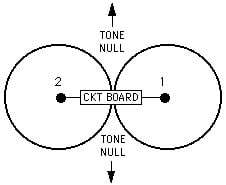 (time of arrival) that appears as a tone on the HT (handi-talkie). As illustrated on the right, the tone will be null (i.e. minimum volume) when the antennas are equidistant from the hidden transmitter, thereby providing a vector to/from the hidden transmitter once several bearings or vectors have been established and plotted on a map the location of the Fox can be estimated. Mike (K6YMM) presentation on the technique can be found here.
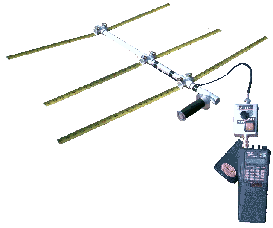 Growing in popularity is the Tape Measure Yagi with a variable attenuator (step attenuator or an offset attenuator). The directional nature of a Yagi enables hunters to point straight at the hidden transmitter. As the Fox Hunter approaches the Fox, attenuation is required (otherwise the HT will be overloaded, and the S-meter will not show a peak).
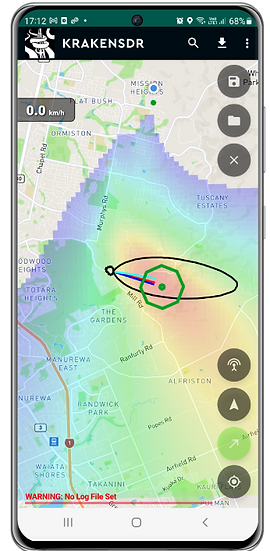
The club continues to explore other RDF technologies. Most recently, testing the KrakenSDR, which uses five coherent receivers feeding data into a Raspberry Pi running the MUSIC (Multiple Signal Classification) algorithm. MUSIC is able to estimate DOA (direction of arrival) and, together with an Android phone, displays a heat map and a vector straight to the hidden transmitter!